
Training triceps with dumbbells involves 5 isolation exercises that develop the whole triceps, and you can do them at home or at the gym with just 1 pair of dumbbells.
These exercises work best as part of a full arm session, but you can still do them on their own when you only have a pair of dumbbells. Besides the 5 dumbbell exercises, you can swap in 2 equipment-free exercises at home, or 4 cable and machine exercises at the gym.
What Are Bingo Wings, and Why Train Triceps?
Bingo wings are sagging skin and fat on the underside of the upper arm, caused by weak triceps combined with the layer of fat under the skin in that area.
So improving them takes two things: firming up the triceps and reducing overall body fat. The detailed causes and a dedicated plan are in our article on flabby arms.
Does training triceps reduce arm fat?
No. The body loses fat all over rather than just in the area you train, but training triceps firms the muscle, so your arms look slimmer when combined with overall fat loss.
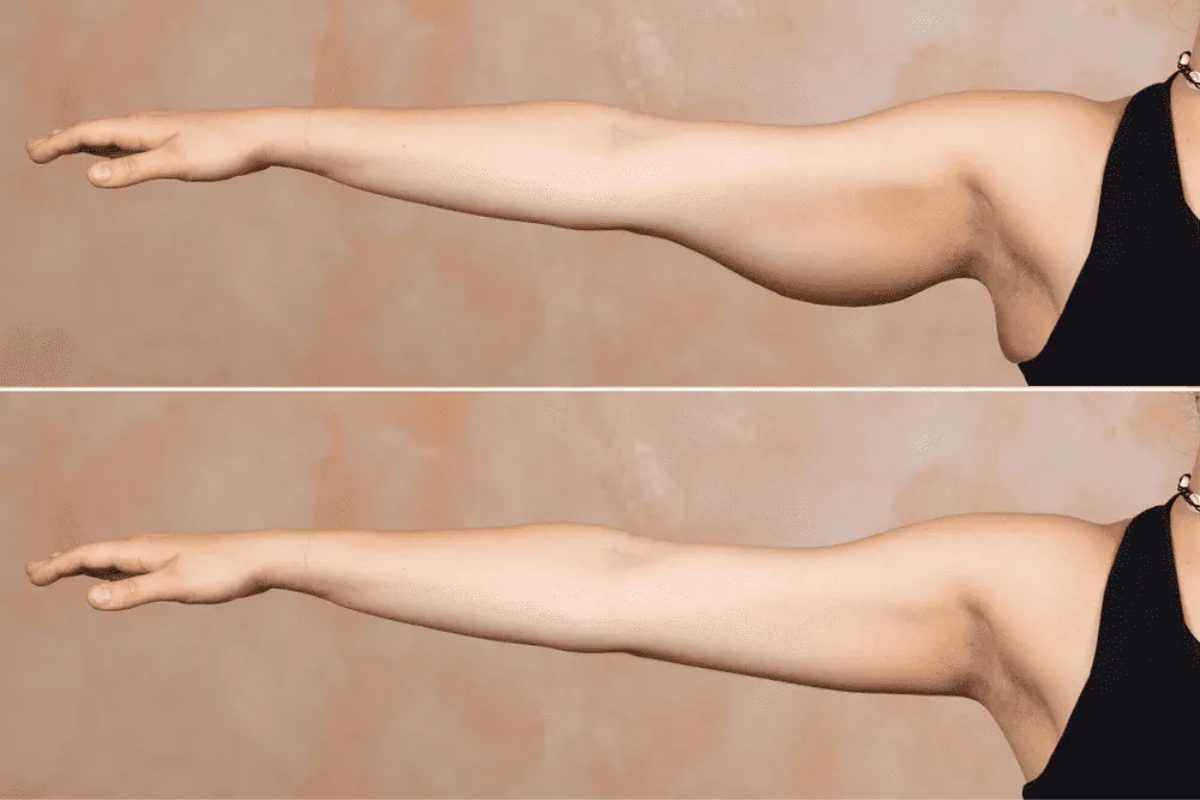
There’s also no exercise that makes the triceps “more defined”. Definition depends on the muscle you already have under the skin and the layer of fat covering it, and exercise can only change the muscle. The tight, pumped feeling after high-rep sets is just blood temporarily rushing into the muscle and fades within a few hours. So to make your arms look slimmer, combine tricep training with cardio and diet to reduce overall body fat.
Which Muscles Do Tricep Exercises Work?
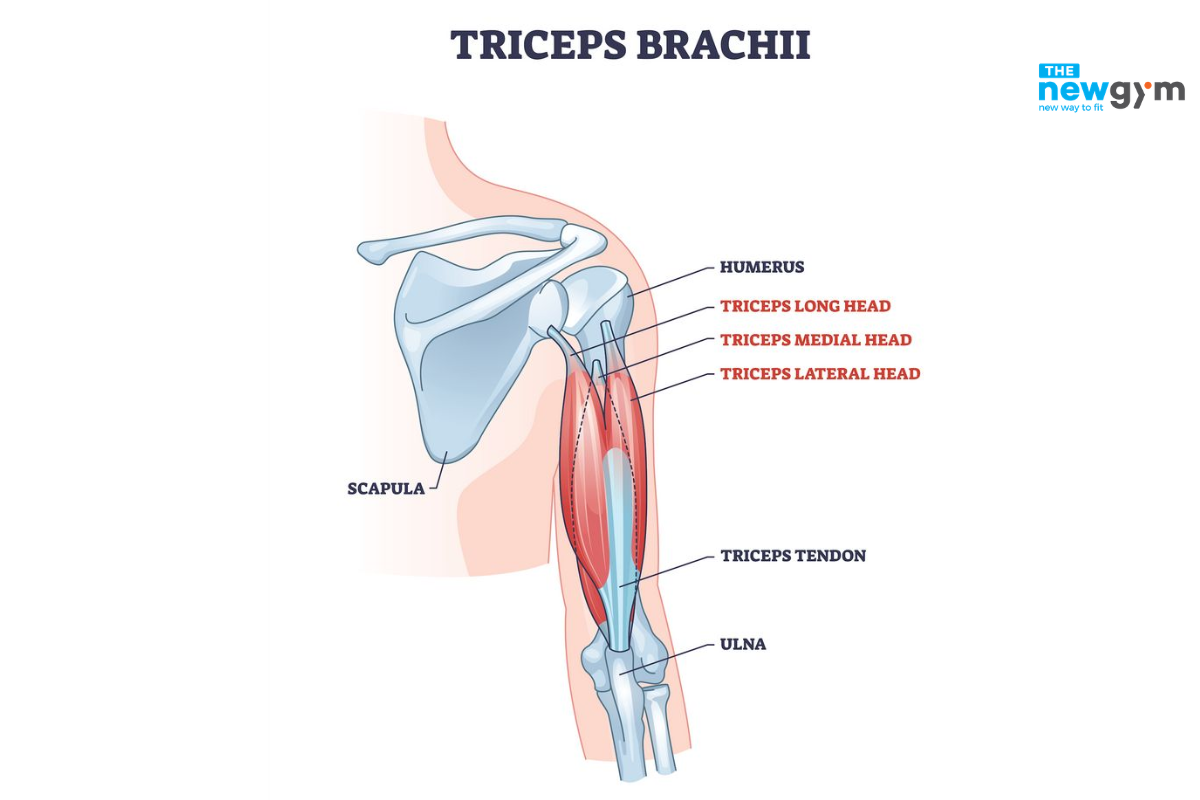
Training triceps with dumbbells means using dumbbells to specifically train the triceps brachii, a muscle that makes up about 2/3 of your upper arm mass.
The triceps brachii is the largest muscle on the back of the upper arm. Its main job is to straighten the elbow, so every pressing movement in the gym, from the Bench Press to the Shoulder Press, needs it. Don’t confuse it with the triceps surae, the calf muscles trained with calf raises, which have nothing to do with arm exercises.
The triceps has 3 heads, and each needs its own technique:
- Long Head: the largest head, running from the shoulder blade. Strongly activated when the arm is overhead (Overhead Extension, Skullcrushers).
- Medial Head: sits close to the upper arm bone and works in every arm-straightening movement.
- Lateral Head: on the outside of the arm, creating the distinctive “horseshoe” shape. Strongly activated in Triceps Kickbacks and Pushdowns.
Why do triceps matter for great-looking arms?
The triceps make up most of your upper arm mass, so for big, firm arms you need to focus on triceps instead of only training biceps.
Benefits of Training Triceps with Dumbbells
Dumbbells help fix muscle imbalances between your arms, are friendlier on the joints, and let you isolate the muscle better than a barbell.
Some people just don’t get on with barbells, and that’s completely fine. If you’ve plateaued or aren’t seeing the results you hoped for, dumbbells are one way to change things up.
Fix muscle imbalances: dumbbell exercises force each arm to work independently, helping you spot and correct one arm being stronger than the other.
Friendlier on the joints: compared with a straight barbell, dumbbells let your wrists and elbows move along a more natural path, reducing stress and injury risk.
Greater range of motion: dumbbells allow a larger range of motion, giving a better stretch and contraction.
Better isolation: dumbbells let you focus on one arm at a time, so you feel the muscle contract more clearly than with a barbell.
5 Tricep Exercises with Dumbbells
Each of the 5 exercises below works one or more different heads of the triceps, so combine them for well-rounded development.
1. Triceps Kickbacks
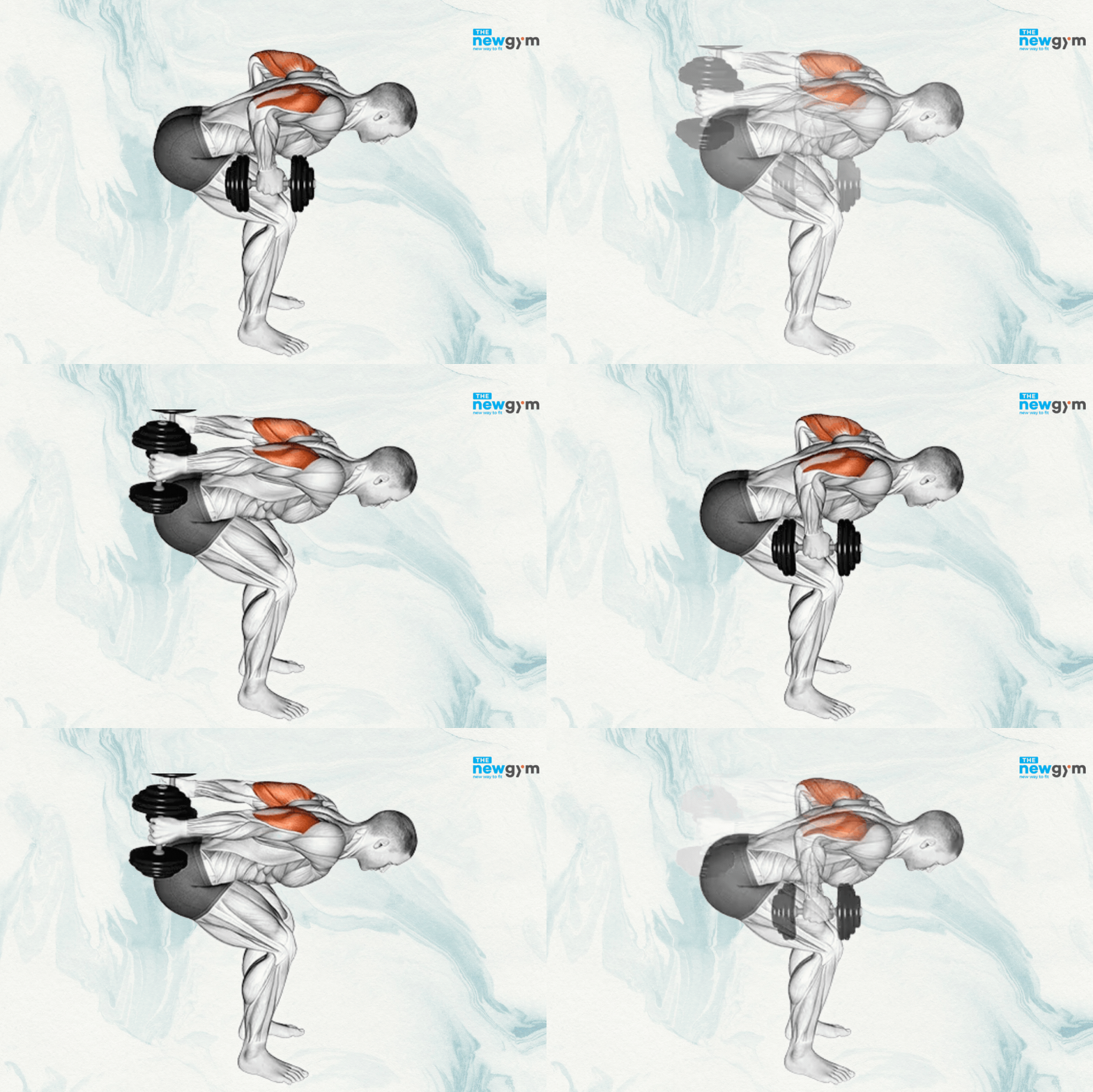
This isolation exercise can be done with or without a bench, so it’s easy to do at home. It focuses on squeezing the triceps at the point of peak contraction.
- Hold a dumbbell in each hand with your elbows bent at 90 degrees.
- Hinge forward at the hips until your torso is almost parallel to the floor. Keep your back straight.
- Keeping your upper arms still and parallel to the floor, extend your forearms straight back.
- Hold for a beat at full extension, squeeze your triceps, then slowly return to the start.
Mistakes to avoid: swinging the weights back with momentum, dropping your elbows during the movement. This exercise is hardest at the end of the movement, so it works best as a finisher with light weights.
2. Skullcrushers
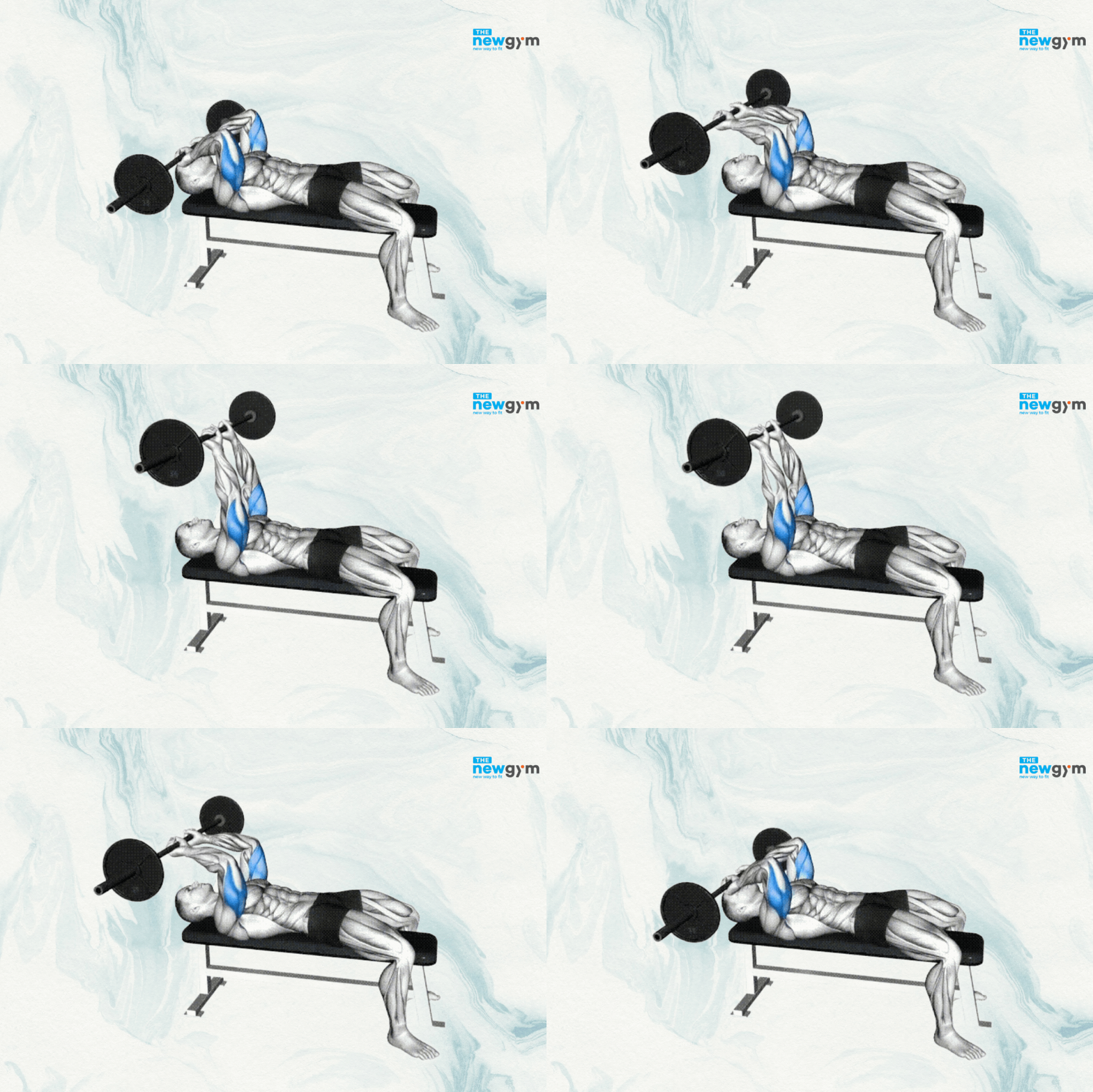
This exercise builds size in all three heads of the triceps, especially the long head.
- Lie on your back on a bench holding a dumbbell in each hand, arms extended above your chest. You can hold the weights with palms facing each other.
- Keeping your upper arms perpendicular to the floor, slowly bend your elbows to lower the weights beside your head.
- Lower until you feel a stretch in your triceps. Lowering the weights past the top of your head, rather than stopping at your forehead, works the long head more.
- Use your triceps to straighten your elbows and bring the weights back to the start.
Mistakes to avoid: letting your elbows flare out, moving your upper arms.
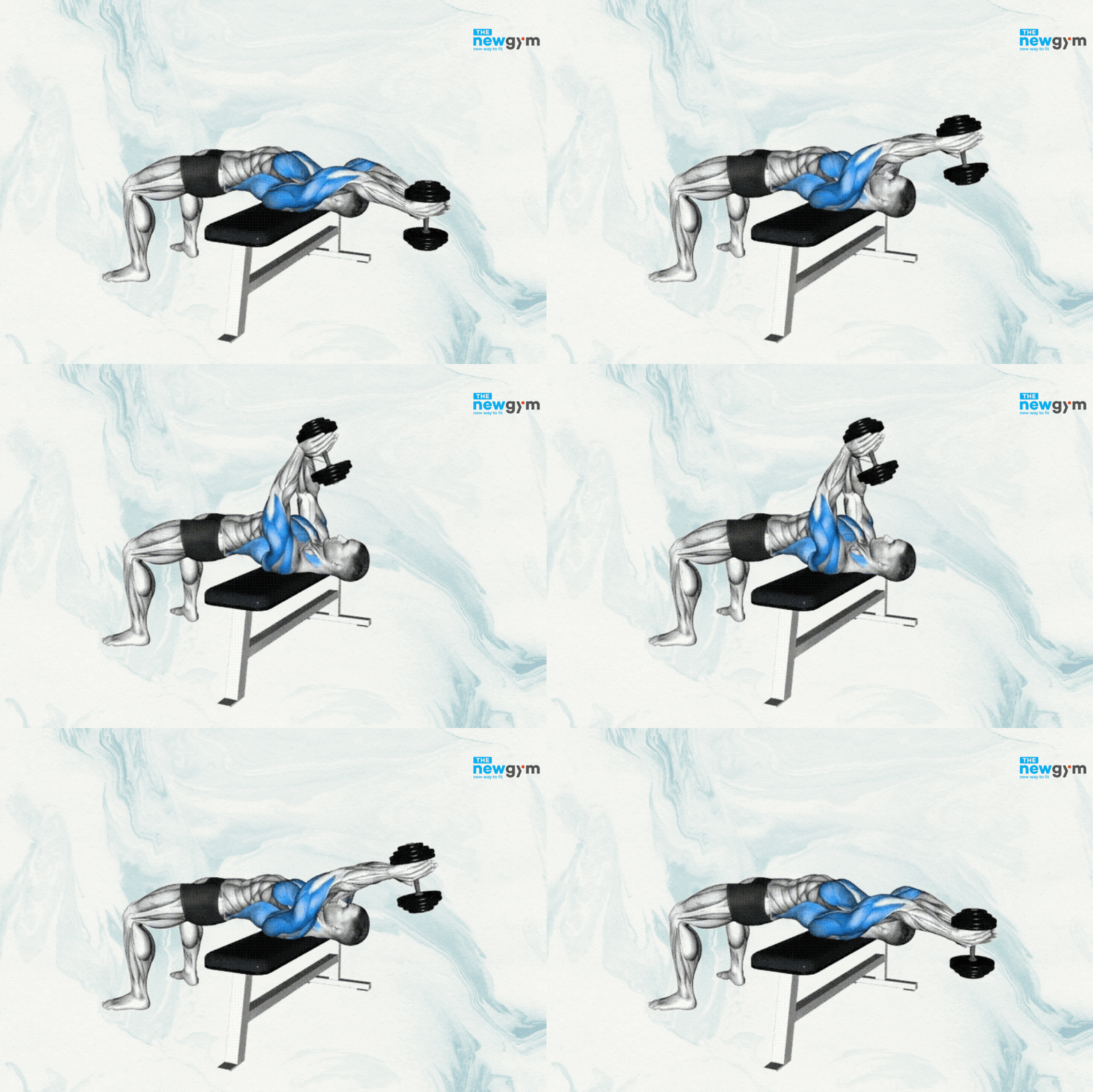
3. Dumbbell Pullovers
This exercise works the triceps, especially the long head, as well as the lats and chest. How to position yourself on the bench and how far to lower the weight are covered in detail in What is the Dumbbell Pullover.
4. Overhead Tricep Extension
Like Skullcrushers, this exercise hits the long head of the triceps hard. A study by Maeo et al. (2023), published in the European Journal of Sport Science, directly compared overhead and neutral arm positions in tricep extensions and found the long head grew about 1.5 times more (+28.5% vs +19.6%) in the overhead position, despite using significantly lighter weights.
That’s why overhead exercises like the Overhead Extension and Skullcrushers are especially effective for overall arm size.
- Sitting or standing, hold one dumbbell with both hands and raise it overhead.
- Slowly lower the weight behind your head by bending your elbows, keeping your upper arms close to your head.
- Straighten your elbows to press the weight back to the start.
5. Close Grip Dumbbell Press
This is a compound exercise that lets you use heavier weights than isolation exercises, building foundational tricep strength. A study by Saeterbakken et al. (2017), published in the Journal of Human Kinetics, measured muscle activity (EMG) in bench-pressing athletes and found an incline bench reduced tricep activation by up to 58–62% compared with a flat bench. So if triceps are your main goal, do this exercise on a flat bench.
- Lie on your back on a bench with a dumbbell in each hand.
- Hold the two dumbbells together above your chest, palms facing each other.
- Slowly lower the weights to your lower chest, keeping your elbows tucked against your sides.
- Press the weights back to the start.
At the gym, you can do the barbell version (Close Grip Bench Press) for long-term progression. A shoulder-width grip is enough, because going narrower doesn’t add tricep work and only puts awkward stress on the wrists.
Equipment-Free Tricep Exercises
The two equipment-free tricep exercises are the Diamond Push-up and Bench Dips, which use bodyweight instead of dumbbells.
Both can be done at home with just some floor space or a sturdy chair, so they suit days when you can’t get to the gym.
1. Diamond Push-up
This is a variation of the push-up where your hands are placed close together under your chest so your elbows stay tucked to your body, working all three heads of the triceps.
- Get into a high plank with your hands together under your chest, forming a triangle.
- Brace your abs so your body is straight from head to heels.
- Lower yourself, keeping your elbows tight to your body.
- Push back up until your arms are nearly straight.
If you’re not strong enough yet, put your hands on a bench or step to reduce the load rather than dropping to your knees, because kneeling changes the angle of your body.
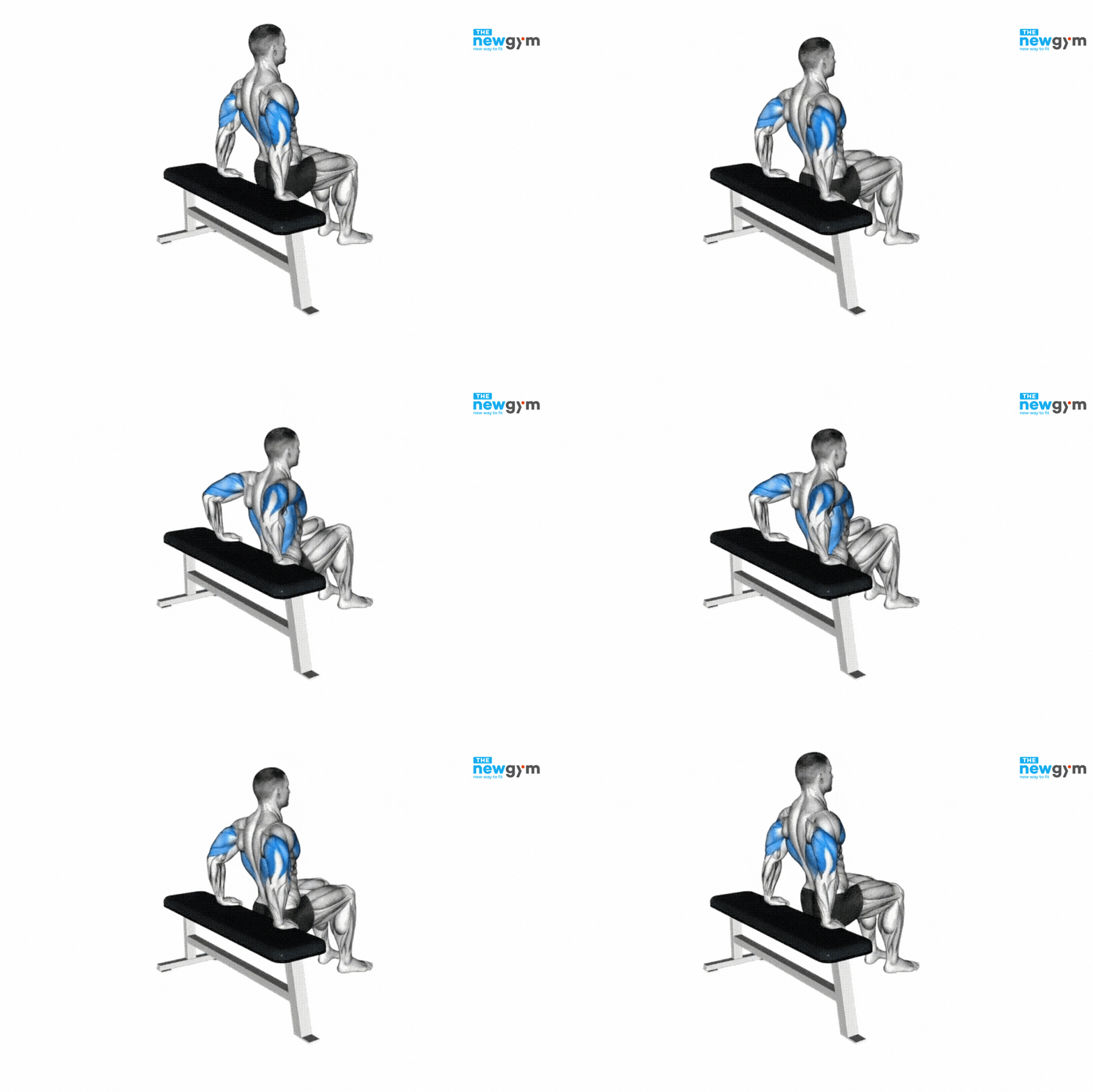
2. Bench Dips
- Sit on the edge of a bench with your hands gripping the edge beside your hips, fingers pointing forward.
- Slide your hips off the bench. Bend your legs to make it easier, or straighten them to make it harder.
- Lower yourself until your elbows are bent at about 90 degrees, keeping your back close to the bench.
- Push yourself up with your triceps, without using your legs to help.
Note if you’ve had shoulder pain: this position takes your arms behind your body and rotates them inward at the same time, narrowing the space under the top of the shoulder. If you’ve had shoulder pain or feel a sharp twinge when lowering, skip this exercise and do Diamond Push-ups or the Triceps Press Machine instead.
Tricep Exercises with Machines at the Gym
The four tricep exercises with gym machines are the Triceps Pushdown, Rope Pushdown, Overhead Cable Extension and Triceps Press Machine.
What sets the cable machine apart is that tension stays even through the whole range, including where the muscle is most stretched, whereas dumbbells lose almost all their load at certain angles because gravity only pulls one way. You can see our training areas and equipment on the facilities page.
1. Triceps Pushdown
This is the most popular cable exercise for triceps; the technique is covered in detail in our Cable Pushdown article.
- Stand facing the cable machine with the pulley set high, holding a straight bar or V-bar at chest height.
- Tuck your elbows against your sides and brace your abs so your body doesn’t sway.
- Push the bar down with your triceps until your arms are nearly straight, moving only your forearms.
- Let it return slowly, keeping your elbows by your sides.
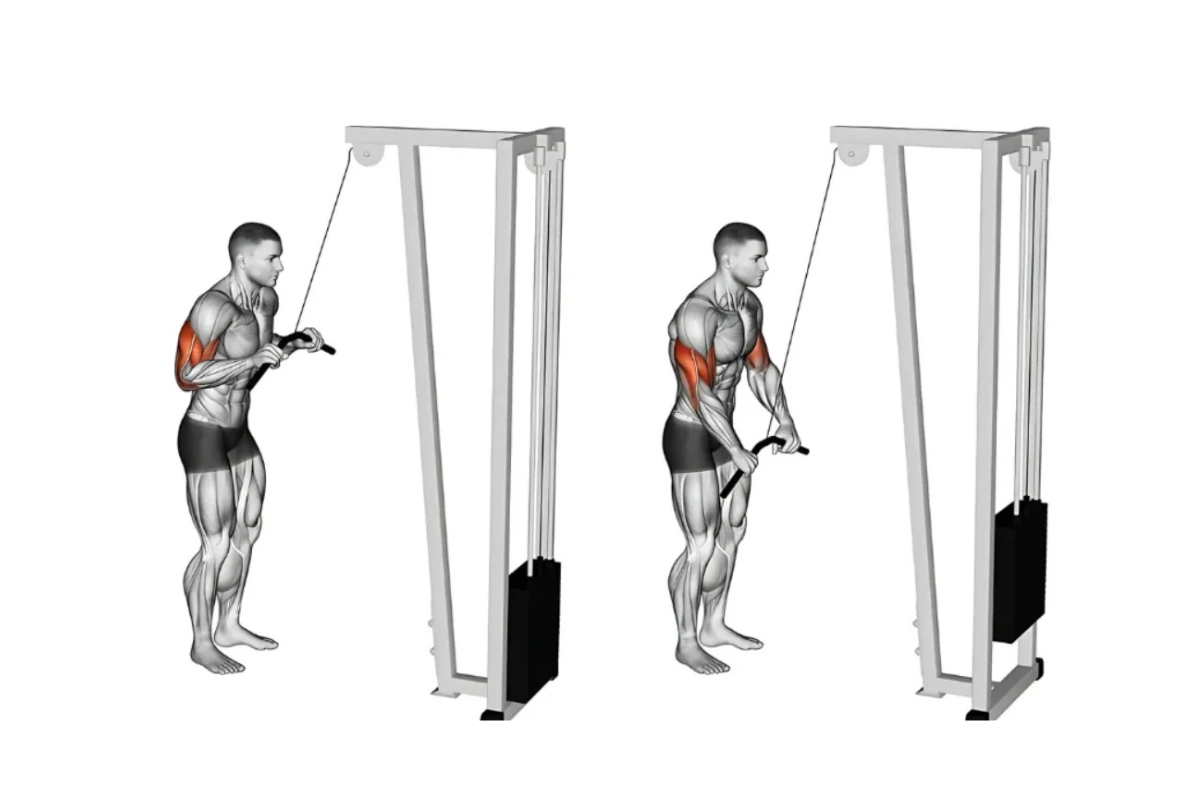
2. Rope Pushdown
- Attach a rope to the high pulley and hold both ends, palms facing each other.
- Tuck your elbows against your sides.
- Push the rope down, and at the end of the movement pull the two ends apart.
- Hold for a beat at full extension, then let it return slowly.
Splitting the rope lets your wrists rotate freely, so the range is greater than the Triceps Pushdown, though you’ll use less weight.
3. Overhead Cable Extension
This exercise keeps tension where the long head is most stretched, something dumbbells can’t do because the direction of gravity changes.
- Stand with your back to the cable machine, attaching the rope to the low or middle pulley.
- Bring the rope overhead, elbows pointing forward and held still.
- Extend your arms straight forward, then lower slowly behind your neck.
4. Triceps Press Machine
The machine has a fixed path, so it suits beginners and doesn’t require balancing like free weights.
- Adjust the seat so your elbows line up with the machine’s pivot.
- Grip the handles and keep your back against the seat.
- Press the handles until your arms are nearly straight, then let them return slowly.
The Triceps Pushdown, Rope Pushdown and Triceps Press Machine all keep your arms by your sides, so they don’t stretch the long head; that’s why each session should also include one overhead exercise.
9 Common Tricep Training Mistakes
The 9 tricep training mistakes are flaring elbows in Skullcrushers, using momentum in Triceps Kickbacks, dropping the elbows, skipping the lowering phase, doing only 1–2 exercises, choosing weights that are too light, locking out the elbows, adding weight every session in Skullcrushers and training triceps the day before chest.
Flaring the elbows during Skullcrushers
This is the most common mistake, especially when going heavy. Elbows flaring out stop the triceps from activating properly and stress the elbow joint.
- How to fix it: keep both elbows pointing straight at the ceiling, parallel to each other. If that’s hard, lower the weight.
Swinging the weight during Triceps Kickbacks
Kickbacks are an isolation exercise, so using your shoulders to swing the weight back almost completely defeats the purpose.
- How to fix it: keep your upper arm parallel to the floor and still throughout. Only extend your forearm back.
Dropping the elbows
When tired, many people unconsciously drop their elbows, turning a tricep extension into a press. The exercise loses its effect and the shoulder becomes prone to injury.
- How to fix it: if you can’t keep your elbows still, lower the weight. Good technique matters more than heavy weight.
Skipping the lowering phase
Beginners often focus on the pushing phase and let the weight drop quickly, but the slow lowering (eccentric) phase strongly stimulates the muscle, so skipping it makes the exercise less effective.
- How to fix it: push up over 1–2 seconds, hold for 1 second at the top, and lower slowly over 2–3 seconds.
Repeating only 1–2 exercises
The triceps have 3 heads, so doing only Triceps Kickbacks and Pushdowns misses the long head, the largest one.
- How to fix it: include at least 3 tricep exercises per session from different angles (overhead, at your sides, close-grip pressing) to hit all 3 heads.
Choosing weights that are too light
This is a common mistake among women. The weight needs to be heavy enough that the last of 10–12 reps feels hard for it to be effective.
Locking out the elbows at the end of the movement
Many people think a rep only counts if the arm is fully straight, so they lock out their elbows at the end of every push. The load then goes into the joint instead of the muscle, and the triceps get a rest between reps.
- How to fix it: stop just before lockout so the muscle stays under constant load.
Adding weight every session in Skullcrushers
Skullcrushers are an isolation exercise, but many people add weight as fast as they do on chest exercises, which easily leads to elbow pain.
- How to fix it: apply progressive overload by adding reps first, and only add weight once you hit all your reps in all 3 sets for 2 sessions in a row.
Training triceps the day before chest
The triceps work in every chest press, so training them on their own the day before will weaken your chest session the next day.
- How to fix it: train triceps in the same session as chest, or keep the two sessions at least 48 hours apart.
Sets, Reps and Rest Times by Goal
Choosing the right reps and rest times for your goal makes your tricep sessions more effective.
| Goal | Rep/set | Rest time |
|---|---|---|
| Building muscle | 8–12 rep | 60–90 seconds |
| Building strength | 5–8 rep | 2–3 minutes |
| Toning | 12–15+ rep | 30–60 seconds |
A Dumbbell Tricep Workout Plan
The sample plan below balances compound and isolation exercises while working all 3 heads of the triceps.
Warm-up: 5–10 minutes of light cardio and dynamic stretches for the shoulders and elbows.
Main exercises:
- Close Grip Dumbbell Press: 3 sets x 8–12 reps
- Skullcrushers: 3 sets x 10–15 reps
- Overhead tricep extension: 3 sets x 10–15 reps
- Triceps Kickbacks: 3 sets x 12–15 reps per side
Cool-down: stretch your triceps, shoulders and chest. After training, arm and shoulder stretches help relieve tension in your triceps and shoulders.
An 8-Week Plan for Women Starting Out
| Week | Frequency | Exercises/session | Set x Rep | Weight |
|---|---|---|---|---|
| 1–2 | 2 sessions | 2 exercises | 3×12 | 1–2kg/tay |
| 3–4 | 2 sessions | 3 exercises | 3×12–15 | 2–3kg/tay |
| 5–6 | 2–3 sessions | 4 exercises | 3×10–12 | 3–5kg/tay |
| 7–8 | 3 sessions | 4–5 exercises | 4×10–12 | 5–7kg/tay |
Frequency and Tips for Tricep Training
Train triceps 1–2 times a week depending on your level, at least 48 hours apart, and adjust your exercises if you have an elbow or wrist injury or are pregnant.
The CDC’s physical activity guidelines set a minimum of 2 days of muscle-strengthening activity a week for the major muscle groups, including the arms.
Frequency by level:
- Beginners (0–3 months): 2 sessions with tricep work a week, which can be 1–2 tricep exercises added to your Push Day.
- Intermediate (3–12 months): 2 tricep sessions a week, which you can split into one heavy session and one higher-volume session.
- Experienced lifters: 2–3 sessions a week with advanced variations like the Close-Grip Bench Press, JM Press and Tate Press.
Splitting sessions: spread your weekly tricep sets across 2 sessions at least 48 hours apart instead of cramming them into 1. Each session will be shorter and it’s easier to keep good technique on the last sets.
Total volume: 6–14 sets a week for triceps alone is enough for most people, counting sets from chest and shoulder presses, since the triceps are already worked indirectly in the Bench Press, Push-up and Shoulder Press.
Exercise order: barbell exercises first while you’re fresh, cable and machine exercises in the middle, and dumbbell exercises at the end.
Some tips for tricep training
People with elbow injuries: avoid heavy Skullcrushers and Overhead Extensions. Start with very light Triceps Kickbacks.
People with wrist pain: Skullcrushers and Close Grip Presses put pressure on the wrists, so use a neutral grip if you can.
Pregnant women: check with your doctor before lifting weights, and avoid lying-on-your-back exercises like Skullcrushers and Dumbbell Pullovers if your doctor advises it.
New mothers: ask your doctor when to return to weight training, and start with bodyweight exercises.
People over 40: favour Triceps Kickbacks and seated Overhead Extensions with light weights, going up to 15–20 reps to reduce stress on the joints.
Elbow and Shoulder Pain When Training Triceps
Elbow pain when training triceps is usually caused by increasing the load faster than the tricep tendon can adapt, while shoulder pain is common in exercises that take the arms overhead or behind the body.
This article is for reference only and does not replace diagnosis and advice from a medical professional.
The tricep tendon attaches to the point of the elbow and takes all the force of straightening it. When training volume rises faster than the tendon can adapt, the area right by the elbow can ache dully, most noticeably at the start of a set and easing as the muscle warms up. This kind of pain is different from post-workout muscle soreness, which spreads evenly across the belly of the muscle.
Situations that often lead to elbow pain:
- Adding weight to Skullcrushers too quickly: this exercise loads the tendon at its deepest range.
- Doing the Close Grip Bench Press with too narrow a grip: the force shifts to the wrists and inner elbow.
- Locking out the elbows on every rep during heavy Pushdowns.
Signs you should stop training right away:
- Sharp pain at one spot on the elbow: stop training and rest for 1–2 weeks.
- Numbness in the little and ring fingers: may be caused by compression of the ulnar nerve; check your elbow position, and if the numbness lasts or keeps coming back, see a doctor.
- Shoulder pain during Overhead Extensions: switch to exercises that don’t take your arms overhead.
- Lasting wrist pain: switch to a neutral grip or reduce the intensity.
See a doctor if: pain at one fixed spot near the elbow lasts more than 2 weeks despite reducing the load, there’s clear swelling at the back of the elbow, you can’t fully straighten your arm, or you hear a pop with a sudden loss of strength while pressing. The AAOS OrthoInfo site describes elbow injuries and when to see a doctor.
Good technique with light weights always beats heavy weights with bad form. You can try 7 days of free training at The New Gym for personalised advice.

FAQ: Frequently Asked Questions About Training Triceps with Dumbbells
1. How long does it take to see results from dumbbell tricep training?
With 1–2 tricep sessions a week and enough protein, you’ll usually feel firmer arms after 4–6 weeks and see clearly bigger arms after 8–12 weeks.
2. What dumbbell weight should beginners use for triceps?
Choose a weight that lets you complete 12–15 reps with good technique. As a guide, men can use 5–10kg for Skullcrushers and Close Grip Presses and 3–5kg for Triceps Kickbacks. Women can use 2–5kg for compound exercises and 1–3kg for Kickbacks.
3. Do I need to add barbell work to dumbbell tricep training?
It’s not required, but combining them is better. Dumbbells are great for balancing both sides and range of motion, while barbells allow heavy loads in compound exercises like the Close Grip Bench Press. Dumbbells are enough for beginners; after 4–6 months you can add barbell work to build strength.
4. Which exercise is best if I can only pick 1?
The Triceps Pushdown is the best choice if you have a cable machine, because it keeps constant tension, is easy to control and is safe for beginners. If you only have dumbbells, Skullcrushers are the best alternative. At home without equipment, go for the Diamond Push-up.
💪Articles on triceps
A collection of 5 articles about triceps, ordered by how often they are read.
References
- Maeo, S., Wu, Y., Huang, M., Sakurai, H., Kusagawa, Y., Sugiyama, T., Kanehisa, H., & Isaka, T. (2023). Triceps brachii hypertrophy is substantially greater after elbow extension training performed in the overhead versus neutral arm position. European Journal of Sport Science, 23(7), 1240–1250. https://pubmed.ncbi.nlm.nih.gov/35819335/
- Saeterbakken, A. H., Mo, D. A., Scott, S., & Andersen, V. (2017). The Effects of Bench Press Variations in Competitive Athletes on Muscle Activity and Performance. Journal of Human Kinetics, 57, 61–71. https://pmc.ncbi.nlm.nih.gov/articles/PMC5504579/
- Centers for Disease Control and Prevention (CDC). Adult Activity: An Overview. https://www.cdc.gov/physical-activity-basics/guidelines/adults.html
- American Academy of Orthopaedic Surgeons (AAOS), OrthoInfo. Elbow Injuries in the Throwing Athlete. https://www.orthoinfo.org/diseases–conditions/elbow-injuries-in-the-throwing-athlete/
About The New Gym
The New Gym is a gym chain with 15 clubs in Ho Chi Minh City, Can Tho, Da Nang and Dong Nai. Most clubs are open 24/7, while Can Tho and Bien Hoa are open from 5am to midnight (see opening hours for each club). Memberships start from 299,000 VND/month on the 6-month plan, including 11+ free group classes. Guided by our “Gym for everyone” philosophy, first-time visitors get a 7-day free trial.
📞 Hotline: 1900 63 69 20
📌 Facebook: facebook.com/thenewgymvietnam
💬 Zalo: zalo.me/4267108480570109866


