
Chest training is a group of exercises that target the pectoralis major, divided into the upper, middle and lower chest, along with the supporting front shoulders and triceps.
The chest responds best when trained from multiple angles, so a chest session with only the Bench Press usually misses the upper and lower chest. Many people also give up because they think they need a gym to train their chest, when push-up variations cover most of what you need at home.
The New Gym brings it all together in the article below: chest anatomy, how to tell the three chest areas apart, and 16 exercises grouped by barbell, dumbbell, machine and home exercises, suitable for beginners too.
What parts make up the chest muscles?
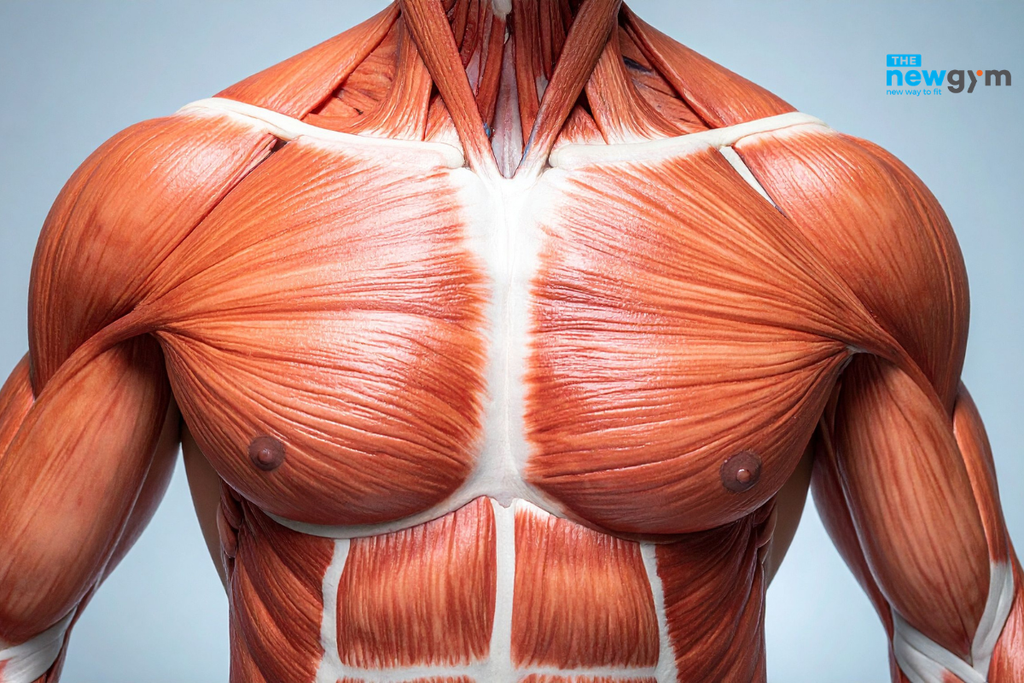
The pectoralis major is the main muscle of the chest, made up of two heads with different attachments, divided by the area each one works.
Clavicular head: attached to the collarbone, forming the upper chest. The clavicular head is activated most when pressing at an upward angle, as in the Incline Bench Press.
Sternocostal head: attached to the breastbone and rib cartilage, making up most of the chest’s mass. The sternocostal head works hardest in horizontal presses such as the Flat Bench Press.
Lower chest: the lowest part of the sternocostal head, strongly activated when pressing at a downward angle, as in the Decline Bench Press or Chest Dips.
Pectoralis minor: lies deep under the pectoralis major and pulls the shoulder blade forward and down. It does not create visible size but affects your shoulder posture.
Front shoulders and triceps: two supporting muscle groups involved in every chest press. Weak front shoulders or triceps are often the reason you cannot increase your Bench Press weight.
What are the benefits of chest training?
Chest training increases pushing strength, balances the upper body, also works the shoulders and triceps, and can be done anywhere.
Greater pushing strength: the chest is the main muscle group in every forward push, from pushing a heavy door to lifting a box away from your body.
A balanced upper body: a strong chest together with a strong back keeps your shoulders in a neutral position. Training the chest alone while neglecting the back does the opposite and tends to pull your shoulders forward.
Supports other muscle groups: a chest session also works the front shoulders and triceps, making it a very time-efficient session.
Trainable anywhere: the chest is one of the few large muscle groups you can train effectively with just your body weight, thanks to push-up variations.
The CDC recommends that adults do muscle-strengthening activities at least 2 days a week, covering all major muscle groups, including the chest.

16 chest exercises for a firm, defined chest
The list below is a library of exercises to choose from based on the equipment you have, not a plan for a single session. Each chest session only needs 4 to 6 exercises.
Barbell chest exercises
1. Barbell Bench Press
The Barbell Bench Press works the whole chest with a focus on the middle, while also recruiting the front shoulders and triceps. It is the chest exercise that lets you lift the heaviest weight.
How to do it:
- Lie on your back on a flat bench, feet planted firmly on the floor, glutes and upper back pressed against the bench.
- Squeeze your shoulder blades together and keep them there throughout the exercise to give your shoulders a stable base.
- Grip the bar slightly wider than shoulder-width and lower it to lightly touch the middle of your chest, elbows at about 45 to 60 degrees from your body.
- Press the bar up until your arms are almost straight, keeping a slight bend in your elbows at the top.
Mistake to avoid: flaring your elbows out to 90 degrees from your body. This angle increases stress on the front of the shoulder joint. Always train with a spotter or in a rack with safety bars when lifting heavy.
2. Incline Barbell Bench Press
The Incline Barbell Bench Press focuses on the upper chest, the area that usually develops slowest in people who only use a flat bench.
How to do it:
- Set the bench at an incline of about 30 degrees.
- Lie back, squeeze your shoulder blades and grip the bar slightly wider than shoulder-width.
- Lower the bar to touch your upper chest, just below your collarbone.
- Press the bar up almost vertically until your arms are nearly straight.
Mistake to avoid: setting the bench steeper than 45 degrees. The steeper the angle, the more your front shoulders take over and the less your upper chest works.
3. Decline Barbell Bench Press
The Decline Barbell Bench Press strongly targets the lower chest and reduces stress on the shoulder joints compared with a flat bench.
How to do it:
- Set the bench at a decline of about 15 to 30 degrees and hook your feet under the foot pads.
- Lie back, squeeze your shoulder blades and grip the bar slightly wider than shoulder-width.
- Lower the bar to touch your lower chest.
- Press the bar up until your arms are almost straight, without locking your elbows.
Mistake to avoid: unracking the bar by yourself while lying on a decline. Control is much harder in this position, so you need a spotter to hand you the bar and take it back.
Dumbbell chest exercises
4. Dumbbell Bench Press
The Dumbbell Bench Press allows a deeper range of motion than a barbell and makes each side work independently, which helps fix imbalances between the two sides of your chest.
How to do it:
- Sit on a flat bench with two dumbbells on your thighs, then lean back while using your thighs to kick the dumbbells up to chest level.
- Squeeze your shoulder blades with your feet planted firmly on the floor.
- Lower the dumbbells to the sides of your chest until your forearms are perpendicular to your upper arms, elbows at about 45 degrees.
- Press the dumbbells up and slightly inward, stopping when they nearly touch and your arms are almost straight.
Mistake to avoid: knocking the dumbbells together at the top, which takes tension off your chest.
5. Incline Dumbbell Press
The Incline Dumbbell Press targets the upper chest with a wider range of motion than a barbell, making it a good choice when your shoulders feel uncomfortable with a fixed bar.
How to do it:
- Set the bench at about 30 degrees, sit down and rest the dumbbells on your thighs.
- Lean back and bring the dumbbells to shoulder level, palms facing forward.
- Lower the dumbbells until they are level with your upper chest.
- Press the dumbbells up and slightly inward until your arms are almost straight.
Mistake to avoid: lowering the dumbbells too far below your shoulders. A range beyond what feels comfortable strains the shoulder capsule without adding any benefit for your chest.
6. Dumbbell Fly
The Dumbbell Fly is a chest isolation exercise that takes most of the work away from the triceps, so it fits well after the pressing exercises in a session.
How to do it:
- Lie on your back on a flat bench, holding the dumbbells above your chest with your palms facing each other.
- Keep a slight, fixed bend in your elbows throughout the exercise.
- Open your arms out to the sides in an arc until you feel a stretch in your chest, stopping when your elbows are level with your torso.
- Bring your arms back to the start using your chest, not by pressing with your triceps.
Mistake to avoid: straightening your arms as you open them. Straight arms create a long lever and put all the force on your shoulder joints. Use a much lighter weight than for the Dumbbell Bench Press.
7. Dumbbell Pullover
The Dumbbell Pullover works the chest and lats at the same time, while also recruiting the serratus anterior on the side of your ribs.
How to do it:
- Lie on your back on a flat bench, holding one dumbbell with both hands above your chest.
- Keeping your elbows slightly bent, lower the dumbbell behind your head in an arc.
- Stop when you feel a stretch in your chest and armpits, without going deeper than is comfortable.
- Pull the dumbbell back above your chest using your chest and lats.
Mistake to avoid: arching your lower back as you lower the weight behind you. Keep your ribs down and your core braced throughout.
8. Floor Press
The Floor Press is a chest pressing option when you have no bench, making it a good choice at home. The floor limits how far you lower, so there is less stress on the shoulder joints.
How to do it:
- Lie on your back on the floor with your knees bent and feet flat on the floor.
- Hold two dumbbells at chest level, with your elbows on the floor at about 45 degrees from your body.
- Press the dumbbells up until your arms are almost straight, squeezing your chest at the top.
- Lower the dumbbells until the backs of your elbows lightly touch the floor, pause for a moment, then press again.
Mistake to avoid: dropping your elbows hard onto the floor. Touch lightly and pause; do not use the floor to bounce the weight up.
Machine and cable chest exercises
9. Chest Press Machine
The Chest Press Machine fixes the path of your arms, so it suits beginners and solo sessions. The machine also makes it safer than free weights to push close to failure.
How to do it:
- Adjust the seat so the handles are level with the middle of your chest when seated.
- Sit with your back pressed against the pad and your feet planted firmly on the floor.
- Push the handles forward until your arms are almost straight, squeezing your chest at the end.
- Bring your hands back slowly, keeping tension, without letting the weight drop.
Mistake to avoid: setting the seat too high so the handles are at shoulder level. The New Gym members always get free help using the machines, so ask the staff to adjust it for you in your first session.
10. Pec Fly Machine
The Pec Fly Machine isolates the chest with a fixed path and is the easiest isolation exercise for feeling the muscle work.
How to do it:
- Adjust the seat so the handles are level with the middle of your chest and your upper arms are parallel to the floor when holding them.
- Sit upright against the pad and place your hands on the handles with your elbows slightly bent.
- Squeeze the handles forward until they nearly touch, then pause for one second.
- Open your arms back to the start slowly and with control.
Mistake to avoid: opening your arms too far back at the end of the movement. Stop when your elbows are level with your torso.
11. Cable Crossover
The Cable Crossover keeps constant tension on the chest throughout the range of motion, even when your hands come together. The height of the pulleys decides which area of the chest is worked.
How to do it:
- Set both pulleys above shoulder height and hold one handle in each hand.
- Step one foot forward and lean slightly forward for balance.
- Pull both hands down and across in front of your lower abdomen, keeping your elbows at a fixed bend, and squeeze your chest where your hands meet.
- Bring your hands back slowly, keeping tension.
Mistake to avoid: bending and straightening your elbows as you pull, which turns it into a tricep exercise. Set the pulleys low and pull upward and across if you want to target your upper chest.
12. Chest Dips
Chest Dips use your body weight on parallel bars and strongly target the lower chest when you lean forward.
How to do it:
- Support yourself on the parallel bars and lift your body with your arms almost straight.
- Lean your torso forward about 30 degrees and keep that angle.
- Lower your body until your shoulders are level with your elbows, elbows flaring slightly outward.
- Push yourself back up without locking your elbows at the top.
Mistake to avoid: lowering yourself too far below the point where your shoulders are level with your elbows. Going too deep puts heavy strain on the front of the shoulder joint. Beginners should start with an assisted Dips machine.
Chest exercises at home, no equipment needed
13. Push Up
The Push Up works the chest, front shoulders, triceps and core in a single movement. It is the foundation of all the home exercises.
How to do it:
- Get into a high plank with your palms on the floor slightly wider than shoulder-width, level with your chest.
- Squeeze your glutes and abs so your body forms a straight line from head to heels.
- Lower your body until your chest nearly touches the floor, elbows at about 45 degrees from your body.
- Push back up to the start, squeezing your chest at the end.
Mistake to avoid: letting your hips sag or pushing them up high. If you cannot keep your body straight for 8 reps, switch to exercise 14 first.

14. Incline Push Up
The Incline Push Up is a variation with your hands on a raised surface, reducing the weight on your arms, so it suits beginners who cannot yet do push-ups on the floor.
How to do it:
- Place your hands on the edge of a sturdy table, bench or step, slightly wider than shoulder-width.
- Walk your feet back until your body forms a straight line from head to heels.
- Lower your chest close to the surface, elbows at about 45 degrees.
- Push back up to the start.
Mistake to avoid: using an unstable surface. The higher the surface, the easier the exercise, so gradually lower the height as you get comfortable instead of jumping straight to the floor.
15. Decline Push Up
The Decline Push Up is a variation with your feet raised, putting more weight on your upper chest and front shoulders.
How to do it:
- Place your feet on a bench or high step and your hands on the floor wider than shoulder-width.
- Keep your body in a straight line, bracing your abs so your hips do not sag.
- Lower your body until your chest nearly touches the floor.
- Push back up to the start.
A note on naming: for push-ups, raising your feet is called decline but targets the upper chest, the opposite of benches, where decline means sloping downward and targets the lower chest. Many articles get this wrong.
16. Diamond Push Up
The Diamond Push Up places your hands close together, shifting more work to your triceps and inner chest.
How to do it:
- Get into a high plank and place your hands close together under your chest so your index fingers and thumbs touch to form a diamond.
- Keep your body in a straight line, squeezing your abs and glutes.
- Lower your body until your chest nearly touches the backs of your hands, keeping your elbows close to your body.
- Push back up to the start.
Mistake to avoid: flaring your elbows out as you lower. Keep your elbows close to your body to keep the focus on your triceps and inner chest.
Sets and reps for each chest exercise
The set and rep ranges below are standard coaching practice; adjust them to the weight you can lift with good form.
| Exercise | Sets × reps | Main chest area | Equipment |
|---|---|---|---|
| Barbell Bench Press | 3 – 4 × 6 – 10 | Middle | Barbell, flat bench |
| Incline Barbell Bench Press | 3 – 4 × 8 – 10 | Upper | Barbell, incline bench |
| Decline Barbell Bench Press | 3 × 8 – 12 | Lower | Barbell, decline bench |
| Dumbbell Bench Press | 3 – 4 × 8 – 12 | Middle | Dumbbells, flat bench |
| Incline Dumbbell Press | 3 – 4 × 8 – 12 | Upper | Dumbbells, incline bench |
| Dumbbell Fly | 3 × 12 – 15 | Middle and inner | Dumbbells, flat bench |
| Dumbbell Pullover | 3 × 10 – 12 | Upper and lats | Dumbbells, flat bench |
| Floor Press | 3 × 10 – 15 | Middle | Dumbbells, no bench needed |
| Chest Press Machine | 3 × 10 – 12 | Middle | Machine |
| Pec Fly Machine | 3 × 12 – 15 | Middle and inner | Machine |
| Cable Crossover | 3 × 12 – 15 | Inner and lower | Cable machine |
| Chest Dips | 3 × 8 – 12 | Lower | Parallel bars |
| Push Up | 3 – 4 × 10 – 20 | Middle | None |
| Incline Push Up | 3 × 10 – 15 | Middle | Raised surface |
| Decline Push Up | 3 × 8 – 15 | Upper | Bench or step |
| Diamond Push Up | 3 × 8 – 12 | Inner and triceps | None |
The figures above are standard coaching ranges, not official standards. The CDC gives general guidance of 8 to 12 reps per set for muscle-strengthening exercises, with at least 1 set per exercise, or 2 to 3 sets for better results.
5 common mistakes when training chest
Not retracting your shoulder blades and flaring your elbows too wide are the two most common causes of shoulder pain.
Not retracting your shoulder blades when pressing: letting your shoulder blades slide freely on the bench removes your base and puts stress on the rotator cuff. Squeeze your shoulder blades together and hold them there for the whole set.
Flaring your elbows perpendicular to your body: a 90-degree angle increases stress on the front of the shoulder joint. Keep your elbows at about 45 to 60 degrees.
Using too much weight: signs include arching your back hard, bouncing the bar off your chest, or a range of motion that gets shorter with each rep. Reduce the weight until you can complete all your reps with stable form.
Only doing flat bench presses: the flat bench targets the middle chest, so a session with only the Bench Press misses the upper and lower chest. Each session should include at least one exercise at an angle.
Lowering the weight too fast: letting the weight drop loses most of the muscle’s work in the lowering phase. Lower over about 2 to 3 seconds and press up in about 1 second.
Sample chest workout
Put the heaviest exercise first, while your chest is still fresh and your technique is still stable.
| Order | Exercise | Sets × reps |
|---|---|---|
| 1 | Barbell Bench Press | 4 × 6 – 10 |
| 2 | Incline Dumbbell Press | 3 × 8 – 12 |
| 3 | Chest Press Machine | 3 × 10 – 12 |
| 4 | Cable Crossover | 3 × 12 – 15 |
| 5 | Push Up | 2 × to failure |
The order goes from barbell to dumbbells, then to machines and isolation exercises. The heaviest exercise should come first in the session, while your chest is still fresh and your technique is still stable.
For a home session, switch to: Floor Press, Decline Push Up, Push Up and Diamond Push Up, 3 sets each.
How long does it take to see results from chest training?
With 2 chest sessions a week and enough protein, most people feel a firmer chest after about 6 to 8 weeks.
With 2 chest sessions a week and enough protein, most people feel a firmer chest after about 6 to 8 weeks and see a clear change in thickness after about 3 to 4 months. This is a reference point and varies a lot from person to person.
Your rate of progress depends on whether you gradually increase your training volume. Training with the same weight and the same reps for months will maintain muscle but will not add size.
Your protein intake also has a direct effect. The range often cited for people building muscle is 1.6 to 2 grams of protein per kg of body weight per day; this is a common coaching range, not an official standard.
Read more: Does going to the gym make your bust smaller?
Chest exercises for women
Women train chest with the same exercises as men; the difference lies in the weight and reps.
Women train chest with the same exercises as men; the difference lies in the weight and reps. Strong chest muscles support upper-body posture and balance out the back muscles.
Good exercises to start with include the Chest Press Machine, a light Dumbbell Bench Press, the Incline Push Up and the Pec Fly Machine. Machines control the path of movement, so it is easier to keep good form in your first sessions.
See the details in The New Gym’s article on chest exercises for women.
Who should be careful when training chest?
People with shoulder joint problems, beginners training alone and pregnant women need to adjust their exercises or consult a doctor first.
People with rotator cuff injuries: need guidance from a doctor or physiotherapist before returning to training. OrthoInfo from the American Academy of Orthopaedic Surgeons has a shoulder rehabilitation programme you can review with your doctor.
People who have had pain at the front of the shoulder when pressing: prioritise machines and the Floor Press, since both limit how far you lower, and avoid a heavy Barbell Bench Press while you have pain.
Beginners training alone: use machines or dumbbells instead of a barbell for heavy sets. The barbell needs a spotter or a rack with safety bars.
People with high blood pressure: avoid holding your breath when pressing, and keep breathing steadily throughout the set.
Pregnant women: avoid lying on your back for long periods from the second trimester, and get advice from your obstetrician before training.

FAQ about chest training
1. How many times a week should beginners train chest?
Beginners should train chest twice a week, at least 48 hours apart. The front shoulders and triceps are involved in every press, so they need to rest along with the chest.
2. How many exercises should a chest workout have?
A chest workout should have 4 to 6 exercises, including 1 to 2 heavy presses and 2 to 3 isolation or angled exercises. The 16 exercises in this article are a library to choose from based on your equipment, not a plan for a single session.
3. How should beginners who cannot do push-ups train chest?
Start with knee push-ups or Incline Push Ups with your hands on a bench, while also doing a light Dumbbell Bench Press and Chest Press Machine. Gradually lower the surface once you can do 3 sets of 10 reps.
4. Can push-ups replace the Bench Press?
Push-ups can replace the Bench Press in the early stages, while your body weight is still enough load for your chest to adapt. Once you can easily do more than 20 push-ups, increase the difficulty by raising your feet, wearing a weighted backpack, or switching to weighted presses.
5. How do I train chest with dumbbells but no bench?
Without a bench, you can do the Floor Press and Dumbbell Pullover on the floor. The floor limits how far you lower, so the range of motion is shorter than on a bench, but the stress on your shoulder joints is lower.
6. Is shoulder pain after chest training normal?
Shoulder pain after chest training is not normal. Chest muscle soreness for 24 to 72 hours is normal, but pain in the shoulder joint is usually a sign of poor form, most often not retracting your shoulder blades or flaring your elbows too wide. See a doctor if the pain persists or hurts when you raise your arm overhead.
Effective chest training needs multiple angles, not just a flat bench: one heavy press, one angled exercise and one isolation exercise are enough for most people. Trainers at The New Gym can help you choose exercises that suit your equipment and shoulder condition. Try a 7-day free trial at The New Gym to get started.

Conclusion
Effective chest training needs multiple angles, not just a flat bench: one heavy press, one angled exercise for the upper or lower chest, and one isolation exercise are enough for most people. Train twice a week with weights you can lift with good form, and increase them gradually over time. You can start with the sample workout above, or sign up for a 7-day free trial at The New Gym to get familiar with the machines first.
🏋️♂️Articles on chest
A collection of 9 articles about chest, ordered by how often they are read.
- How to Do Push-Ups Correctly for Beginners
- Bench Press or Chest Press Machine: which is better for your chest?
- How to do the Dumbbell Fly with proper technique for beginners
- Smith Machine Bench Press: A Technique Guide for Beginners
- Effective ways for women to lift and firm the bust
- 3 Accessory Exercises to Improve Your Push-Ups
- Bench Press Guide for Beginners
- Does going to the gym make your bust smaller?
About The New Gym
The New Gym is a gym chain with 15 clubs in Ho Chi Minh City, Can Tho, Da Nang and Dong Nai. Most clubs are open 24/7, while Can Tho and Bien Hoa are open from 5am to midnight (see opening hours for each club). Memberships start from 299,000 VND/month on the 6-month plan, including 11+ free group classes. Guided by our “Gym for everyone” philosophy, first-time visitors get a 7-day free trial.
📞 Hotline: 1900 63 69 20
📌 Facebook: facebook.com/thenewgymvietnam
💬 Zalo: zalo.me/4267108480570109866


