
Shoulder training is a group of exercises that work the deltoids, with their front, middle and rear heads, plus the supporting muscles around the shoulder joint. The middle delts set how wide your shoulders look, the front delts take part in every pressing movement, and the rear delts hold your posture and balance out the forward pull. Many people train shoulders with pressing alone, which leads to uneven development and more stress on the joint.
The New Gym has put together 15 exercises covering all three heads, using dumbbells, barbells, machines and bodyweight at home, plus how to choose the right weight for you.
What muscles make up the shoulder?
The shoulder is made up of the three-headed deltoid and several supporting muscle groups around the shoulder joint.
Front delt (Anterior Deltoid): the front of the shoulder, responsible for raising the arm forward and overhead. The front delt works hard in the Bench Press, Push Up and every overhead press.
Middle delt (Lateral Deltoid): the middle of the shoulder, responsible for raising the arm out to the side. The middle delt sets how wide your shoulders look, so it is the group to train most if your goal is broad shoulders.
Rear delt (Posterior Deltoid): the back of the shoulder, responsible for moving the arm backward. The rear delt works in Rows and Pull Ups, and is the most often neglected group in training plans.
Rotator cuff: four small muscles deep around the shoulder joint that keep the head of the upper arm bone stable in its socket. The rotator cuff adds no visible size but decides whether your shoulder can handle load safely.
Trapezius: runs from the neck down to the upper back, takes part in shrugging and keeps the shoulder blades stable.
Rhomboids: sit between the shoulder blades, pull them toward the spine and hold upper back posture.

What are the benefits of shoulder training?
1. Stronger presses: strong shoulders are the foundation for the Bench Press, Push Up and overhead presses. Weak shoulders are often the bottleneck that stops your chest lifts from progressing.
2. Better upper back posture: the rear delts and rhomboids pull the shoulder blades back, counteracting the rounded shoulders that come from long hours at a computer or looking down at a phone.
3. A more balanced physique: developed middle delts widen the upper body, making your overall proportions look more balanced against your waist.
4. Easier daily life: lifting a suitcase into the overhead bin, carrying boxes and reaching for things up high all rely on the shoulder joint.
5. Lower risk of shoulder injury: strong muscles around the joint keep it more stable under load and through a large range of motion.
The CDC recommends that adults do muscle-strengthening exercise at least 2 days a week, covering all major muscle groups, including the shoulders.
15 shoulder exercises for all three deltoid heads
The list below is an exercise library to choose from based on your equipment, not a single-session plan. Each shoulder session only needs 4 to 6 exercises.
Pressing exercises: building a strength base
1. Dumbbell Shoulder Press
The Dumbbell Shoulder Press mainly works the front and middle delts while also recruiting the triceps. It is a foundation exercise and should go at the start of your session while your muscles are fresh.
How to do it:
- Sit on a bench with an upright back support, or stand with feet shoulder-width apart.
- Bring two dumbbells up to shoulder height, palms facing forward, elbows slightly below the wrists.
- Brace your core and press the weights up until your arms are nearly straight, keeping a slight bend in the elbows at the top.
- Pause for half a second, then lower the weights slowly to shoulder height over about 2 seconds.
Mistake to avoid: arching the lower back when pressing. If your back is bending backward, reduce the weight or switch to a seated, back-supported position.
2. Barbell Overhead Press
The Barbell Overhead Press lets you use more weight than dumbbells, so it suits the goal of building overall shoulder strength. It requires enough wrist and shoulder mobility, so only do it once you are comfortable pressing with dumbbells.
How to do it:
- Stand with feet shoulder-width apart, the bar resting across your upper chest, hands slightly wider than shoulder width.
- Brace your core and squeeze your glutes to keep your body upright.
- Press the bar straight up overhead, tilting your head back slightly so the bar passes close to your face, then bring your head back through once the bar clears your forehead.
- Lower the bar to your upper chest under control.
Mistake to avoid: pressing the bar in an arc out in front of your face. The bar path should be close to vertical so the load goes into the shoulders rather than the lower back. See the full technique in our dedicated Overhead Press article.
3. Shoulder Press Machine
The Shoulder Press Machine fixes the path of the weight, so it suits beginners who can’t yet control free weights. The machine is also the safer choice when training alone with heavy loads.
How to do it:
- Adjust the seat so the handles are at shoulder height when seated.
- Sit with your back flat against the pad, feet planted on the floor, hands on the handles.
- Brace your core and press the handles up until your arms are nearly straight.
- Pause briefly at the top, then lower back to the start slowly and under control.
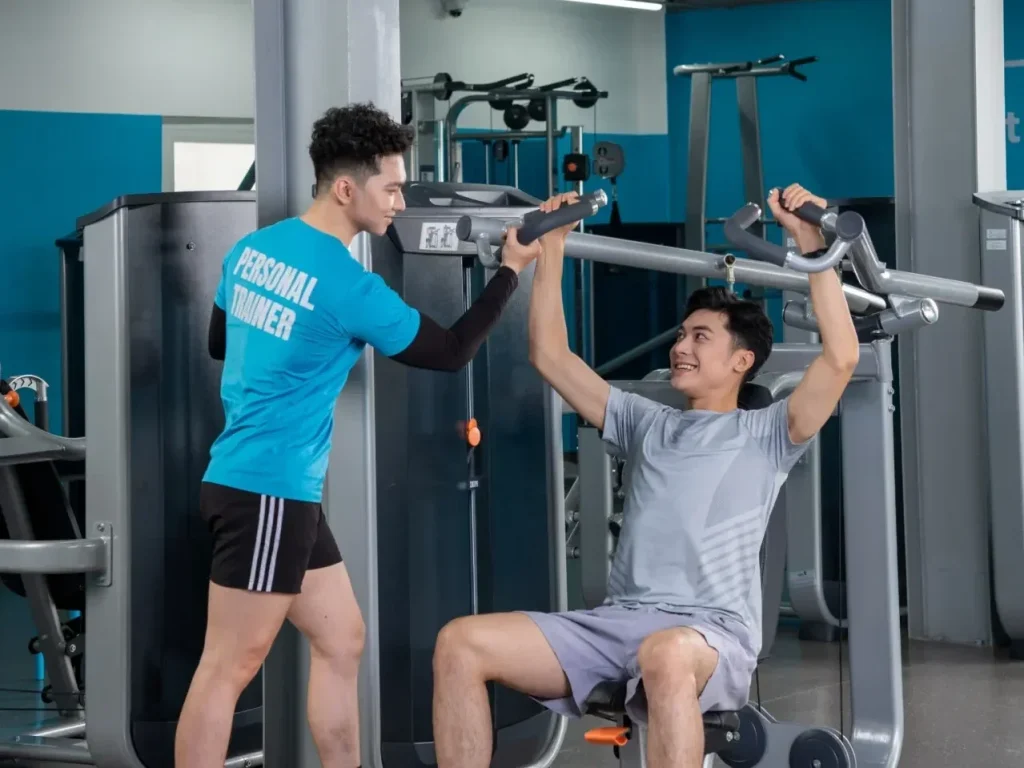
Mistake to avoid: setting the seat too low so the handles sit above your shoulders, which increases stress on the joint. The New Gym members get free help using the machines, so ask the gym staff to set it up for you in your first session.
4. Arnold Press
The Arnold Press is a Shoulder Press variation with an added wrist rotation, which works both the front and middle delts in the same rep.
How to do it:
- Sit upright on a bench with back support, holding the dumbbells at shoulder height with palms facing you.
- Press the weights up while rotating your wrists outward.
- At the top, your palms face fully forward with a slight bend in the elbows.
- Lower the weights in reverse, rotating your wrists back to face you.
Mistake to avoid: rotating the wrists too fast. The rotation should happen smoothly throughout the press, not as a jerk at the end.
5. Pike Push Up
The Pike Push Up is an equipment-free shoulder exercise that uses your bodyweight to work the front and middle delts.
How to do it:
- Get into a push-up position, hands shoulder-width apart.
- Push your hips up into an inverted V, with your hands and feet still on the floor.
- Bend your elbows to lower the top of your head toward the floor, elbows angled back.
- Push yourself back up to the starting position.
Mistake to avoid: letting your back sag on the way down. Beginners can put their hands on a bench or a step to make it easier; once comfortable, raise your feet on a bench to put more load on the shoulders.
Front delt isolation exercises
6. Dumbbell Front Raise
The Dumbbell Front Raise isolates the front delts and is an accessory to your pressing work.
How to do it:
- Stand tall holding two dumbbells in front of your thighs, palms facing down.
- Keep a slight bend in the elbows and your torso still.
- Raise your arms straight out in front until the weights reach shoulder height.
- Lower the weights slowly to the start over about 2 seconds.
Mistake to avoid: lifting above shoulder height and leaning back for momentum. The front delts already work a lot in chest presses, so 1 Front Raise exercise per shoulder session is enough.
Middle delt isolation exercises
7. Dumbbell Lateral Raise
The Dumbbell Lateral Raise is the most important exercise for shoulder width because it directly isolates the middle delt.
How to do it:
- Stand tall holding two dumbbells at your sides, palms facing in.
- Keep a slight bend in the elbows throughout.
- Raise your arms out to the sides until they are parallel to the floor, elbows no higher than your shoulders.
- Lower the weights slowly over about 2 seconds back to the start.
Mistake to avoid: lifting above the shoulders. Past shoulder height, the traps take over most of the work and pressure builds under the top of the shoulder (the acromion).
8. Cable Lateral Raise
The Cable Lateral Raise works the middle delt like the Dumbbell Lateral Raise, but keeps tension even through the whole range, including at the bottom.
How to do it:
- Set the pulley to its lowest position and attach a D-handle.
- Stand side-on to the machine, holding the handle with the hand farther from it, the cable running across the front of your body.
- Raise your arm out to the side to shoulder height and hold for a beat.
- Lower your arm slowly back to the start; finish one side, then switch.
Mistake to avoid: rotating your torso with the pull. You can hold the machine frame with one hand to keep your body still.
9. Lateral Raise Machine
The Lateral Raise Machine fixes the arm path, so beginners can feel the middle delt working more easily than with dumbbells. The machine also limits momentum.
How to do it:
- Adjust the seat so your shoulder joint lines up with the machine’s pivot.
- Sit upright, chest lightly against the pad, upper arms resting on the arm pads.
- Push your arms out to the sides until your upper arms reach shoulder height.
- Hold for a beat, then lower slowly without letting the weight drop.
Mistake to avoid: shrugging as you push. Keep your shoulders down throughout so the traps stay out of it.
10. Upright Row
The Upright Row works the middle delts and traps in one movement. Limit the range, because pulling too high increases the risk of impingement in the shoulder joint.
How to do it:
- Stand tall holding a barbell or two dumbbells in front of your thighs, hands shoulder-width apart.
- Pull the weight up along your body, leading with the elbows and keeping them higher than your wrists.
- Stop when the weight reaches your lower chest; don’t pull any higher.
- Lower the weight slowly over 2 to 3 seconds.
Mistake to avoid: using a very narrow grip and pulling the weight up to your chin. If you feel pain at the front of the shoulder during this exercise, drop it entirely and do Lateral Raises instead.
Rear delt exercises
11. Bent-Over Lateral Raise
The Bent-Over Lateral Raise isolates the rear delts, the most often neglected group in shoulder training.
How to do it:
- Stand with feet shoulder-width apart, holding two dumbbells.
- Hinge forward about 70 to 90 degrees, back straight and core braced, arms hanging with palms facing each other.
- Raise your arms out to the sides to shoulder height, squeezing your shoulder blades together.
- Lower the weights slowly to the start.
Mistake to avoid: using the same weight as your Lateral Raise. The rear delts are small, and heavy weights shift the work to your back muscles and momentum.

12. Face Pull
The Face Pull works the rear delts and the shoulder’s external rotators, while also supporting upper back posture.
How to do it:
- Set the pulley at face height and attach a rope.
- Stand a step away from the machine, holding both ends of the rope with palms facing each other.
- Pull the rope toward your face, flaring your elbows out to the sides and keeping them at shoulder height.
- Hold for a beat, squeeze your shoulder blades, then release under control.
Mistake to avoid: dropping the elbows as you pull, which turns it into a back row. If you sit at a desk a lot, you can add Face Pulls to your back sessions too.
13. Rear Delt Machine Fly
The Rear Delt Machine Fly isolates the rear delts with a fixed path, so it’s easier to keep good form than with the Bent-Over Lateral Raise, especially when you’re tired at the end of a session.
How to do it:
- Adjust the seat so the handles are at shoulder height when seated.
- Sit facing the pad, chest pressed against it, hands on the handles with elbows slightly bent.
- Sweep your arms back in an arc until they are in line with your body.
- Hold for a beat, then return slowly, keeping tension throughout.
Mistake to avoid: leaning back to push the weight. Keep your chest against the pad the whole time.
Trap and at-home exercises
14. Dumbbell Shrug
The Dumbbell Shrug works the traps, the area joining the neck and shoulders, making the upper body look fuller and helping hold your posture.
How to do it:
- Stand tall holding two dumbbells at your sides, arms hanging naturally.
- Raise your shoulders straight up as high as you can.
- Hold for one second at the top and squeeze your traps.
- Lower your shoulders slowly to the start.
Mistake to avoid: rolling the shoulders in circles while shrugging. Rotating under load adds stress to the shoulder joint without making the traps work any better.
15. Band Lateral Raise
The Band Lateral Raise is an at-home alternative to the Lateral Raise, using a resistance band instead of dumbbells. Band tension increases through the range, so the end of the movement is harder than the start.
How to do it:
- Stand on the middle of a resistance band, holding one end in each hand.
- Keep a slight bend in the elbows and your body upright.
- Raise your arms out to the sides to shoulder height.
- Lower your arms slowly to the start, without letting the band snap them down.
Mistake to avoid: choosing a band so heavy you have to jerk through the end of the movement. Pick a band that lets you complete 15 reps with good form, or use full water bottles if you don’t have a band yet.

Sets and reps for each shoulder exercise
| Exercise | Sets × reps | Main head | Weight |
|---|---|---|---|
| Dumbbell Shoulder Press | 3 – 4 × 8 – 12 | Front and middle delts | Moderate |
| Barbell Overhead Press | 3 – 4 × 6 – 10 | Front and middle delts | Heavier |
| Shoulder Press Machine | 3 × 10 – 12 | Front and middle delts | Moderate |
| Arnold Press | 3 × 8 – 12 | Front and middle delts | Moderate |
| Pike Push Up | 3 × 8 – 12 | Front and middle delts | Bodyweight |
| Dumbbell Front Raise | 3 × 10 – 12 | Front delts | Light |
| Dumbbell Lateral Raise | 3 – 4 × 12 – 15 | Middle delts | Light |
| Cable Lateral Raise | 3 × 12 – 15 | Middle delts | Light |
| Lateral Raise Machine | 3 × 12 – 15 | Middle delts | Light |
| Upright Row | 3 × 10 – 12 | Middle delts and traps | Moderate |
| Bent-Over Lateral Raise | 3 × 12 – 15 | Vai sau | Very light |
| Face Pull | 3 × 12 – 15 | Vai sau | Light |
| Rear Delt Machine Fly | 3 × 12 – 15 | Vai sau | Light |
| Dumbbell Shrug | 3 × 10 – 12 | Traps | Heavier |
| Band Lateral Raise | 3 × 15 | Middle delts | Light to moderate band |
These numbers are common training ranges, not official standards. The CDC gives general guidance of 8 to 12 reps per set for muscle-strengthening exercise, at least 1 set per exercise, and 2 to 3 sets for better results.
How to choose your weight for shoulder training
The most accurate way to choose your weight is by how many reps you can complete with good form, not by your bodyweight.
Starting weight: choose a weight that lets you complete all your target reps while keeping good form on the last 2. If you have to swing your body to finish the last rep, the weight is too heavy.
Isolation is lighter than pressing: Lateral Raises, Front Raises and Bent-Over Lateral Raises use much lighter weights than the Shoulder Press. The middle and rear delts are small muscles, and heavy weights just shift the work to the traps and momentum.
When to go up: once you complete all target reps in every set easily and with good form for 2 sessions in a row, move up to the next small weight increment.
Go up in small steps: for shoulder isolation exercises, even a small increase feels like a big change. Progressing slowly gives the shoulder joint time to adapt.
A sample shoulder workout for everyone
| Order | Exercise | Sets × reps |
|---|---|---|
| 1 | Dumbbell Shoulder Press | 4 × 8 – 10 |
| 2 | Dumbbell Lateral Raise | 4 × 12 – 15 |
| 3 | Bent-Over Lateral Raise | 3 × 12 – 15 |
| 4 | Face Pull | 3 × 12 – 15 |
| 5 | Dumbbell Front Raise | 2 × 10 – 12 |
Always go from pressing to isolation exercises. Presses recruit several muscle groups and take the most effort, so put them at the start while your shoulders are fresh.
Weight the volume toward the middle and rear delts. The front delts already work a lot in chest sessions, so they need only a small amount in your shoulder session.
If the gym is busy and a machine is taken, just swap in another exercise from the same group. The Cable Lateral Raise or Lateral Raise Machine can replace the Dumbbell Lateral Raise, and the Rear Delt Machine Fly can replace the Bent-Over Lateral Raise.
How many times a week should you train shoulders?
Beginners should train shoulders 1 to 2 times a week, at least 48 hours apart. The shoulders are a small muscle group already worked indirectly in chest and back sessions, so training them more often brings no extra benefit.
If you’ve been training for over 6 months, you can split shoulders into 2 sessions a week with different styles: one focused on pressing with heavier weights, the other on isolation with higher reps.
Allow 48 to 72 hours of recovery between shoulder sessions. If your shoulders are still sore when the next session starts, rest longer instead of training through it.
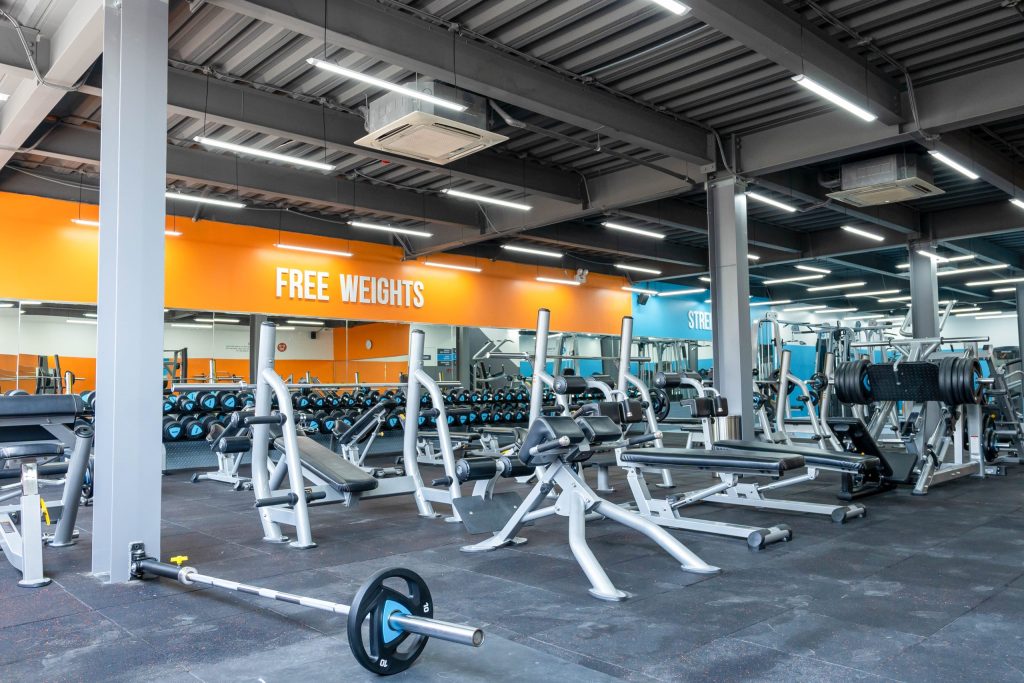
Most The New Gym locations are open 24/7, so you can schedule your two shoulder sessions at quiet times, avoid waiting for machines and keep your rest between sets on track.
If you’re new and still unsure, The New Gym is running a 7-day free trial. You’re free to try our spacious training areas, international-standard equipment and free group classes.

How long does it take for shoulders to look wider?
Shoulder width depends on two things: the width of your shoulder frame and the thickness of your middle delts. Your bone structure is genetic and doesn’t change after adulthood, so the part you can influence is the muscle.
With 2 shoulder sessions a week and enough protein, most people feel firmer shoulders after about 6 to 8 weeks and see a clear change in fullness after about 12 to 16 weeks. These are rough guides and vary a lot from person to person.
The middle delts respond well to high reps and steady volume. Gradually increasing the weight following progressive overload is what matters, not the number of exercises in a session.
Shoulder exercises for women
Women train shoulders with the same exercises as men, only the weights and balance between exercises differ. A 2020 meta-analysis found that women gain muscle at a similar relative rate to men on the same program, but absolute muscle mass is usually smaller. So shoulder training makes women’s shoulders firmer and more defined without suddenly changing their figure.
A good plan for women usually leans toward the Lateral Raise and Bent-Over Lateral Raise with light weights and 12 to 15 reps, plus one pressing exercise. These exercises shape the shoulders and support upper back posture.
If you sit at a desk a lot and often get neck and shoulder tension, prioritise the Face Pull and Bent-Over Lateral Raise, as they directly work the muscles that hold your shoulder blades.
5 common shoulder training mistakes
Using momentum: swinging your body to lift the weight, common in Lateral and Front Raises. The deltoids aren’t properly activated and the strain shifts to the lower back. Lower the weight and use a 2-second up, 2-second down tempo.
Lifting above shoulder height: in isolation exercises, once your arms pass shoulder height the traps take over from the deltoids. Lift only to shoulder height or slightly below.
Locking the elbows when pressing: fully straightening at the top takes tension off the shoulders and loads the elbow joint. Keep a slight bend in the elbows at the top.
Skipping the rear delts: a plan with only presses and Lateral Raises gradually weakens the rear delts and leads to rounded shoulders. Include at least 1 rear delt exercise in every shoulder session.
Not warming up the shoulder joint: grabbing weights and pressing as soon as you arrive raises the risk of rotator cuff injury. Spend 5 to 7 minutes on shoulder circles, Wall Slides and light band Face Pulls before your main work.
Who should be careful with shoulder training?
People with rotator cuff injuries: should be guided by a doctor or physiotherapist before returning to training, rather than choosing exercises themselves. OrthoInfo from the American Academy of Orthopaedic Surgeons has a shoulder rehab program you can review with your doctor.
People with subacromial impingement syndrome: avoid overhead exercises and Upright Rows while it hurts, and limit range of motion as your doctor advises.
People with a history of shoulder dislocation: get an orthopaedic doctor’s opinion before lifting heavy, warm up thoroughly and avoid sudden shoulder rotations.
Beginners over 50: favour fixed-path machines over free weights, using light weights and high reps.
People with high blood pressure: avoid holding your breath when pressing and keep breathing steadily through each set.
Pregnant women and new mothers: get an obstetrician’s advice before training. After a vaginal birth, the commonly cited point to return to exercise is about 6 weeks, and longer after a C-section.
When should you stop shoulder training and see a doctor right away?
Deep pain inside the shoulder joint when raising your arm: unlike normal muscle fatigue, this pain usually appears at a certain point in the range and keeps coming back. Stop training and see a doctor if it lasts more than 1 to 2 weeks.
Numbness or weakness in the arm after training: may be related to nerve compression and needs a doctor’s assessment.
A deformed shoulder you can’t move after an injury: go to a medical facility right away. Call 115 if you can’t move on your own or are in severe pain.
Shoulder pain at night that keeps you awake: a common sign of tendon and joint capsule problems; see a doctor instead of continuing to train.
This article is for reference only and does not replace medical advice.
See also: What is your body telling you when your arms shake during a workout?
FAQ
How many times a week should beginners train shoulders?
Beginners should train shoulders 1 to 2 times a week, at least 48 hours apart. The shoulders already work indirectly in chest and back sessions, so adding more dedicated sessions brings no extra benefit.
Which shoulder exercise matters most for wider shoulders?
The Dumbbell Lateral Raise matters most for shoulder width because it directly isolates the middle delt. Well-rounded shoulders still need all three heads, so pair Lateral Raises with one pressing exercise and one rear delt exercise.
How many exercises should a shoulder session include?
A shoulder session should include 4 to 6 exercises: 1 to 2 presses and 2 to 3 isolation exercises spread across the middle and rear delts. The 15 exercises in this article are a library to choose from based on your equipment, not a single-session plan.
Does shoulder training reduce upper arm fat?
Shoulder training doesn’t reduce fat specifically in the shoulders or upper arms. The body can’t spot-reduce fat; fat comes off across the whole body when you burn more energy than you take in. Shoulder training gives your shoulders and arms more definition as your overall body fat goes down.
Will shoulder training make women’s shoulders much bigger?
Women training shoulders with light to moderate weights and high reps will get firmer, more defined shoulders without gaining size as fast as men. Women build muscle at a similar relative rate to men, but absolute muscle mass is usually smaller, so the shoulders are unlikely to get overly big.
Should I train shoulders before or after chest day?
Keep shoulder training at least 48 hours from chest day. The front delts work hard in every chest press, so scheduling the two back to back can easily overload them.
What shoulder exercises can I do at home without weights?
At home without weights, you can do Pike Push Ups for the front and middle delts, plus Band Lateral Raises and Face Pulls with a resistance band. Full water bottles can also stand in for light dumbbells in isolation exercises.
In short: train all three deltoid heads
Effective shoulder training needs all three deltoid heads, not just pressing. Prioritise the middle delts for width, add at least one rear delt exercise each session to protect your posture, and train 1 to 2 times a week with weights that let you keep good form. You can start with the 5 exercises in the sample workout above, or ask The New Gym staff to show you how to set up the machines in your first session.
🤷Articles on shoulders
A collection of 11 articles about shoulders, ordered by how often they are read.
- How to train at the gym without uneven shoulders or muscle imbalances
- A Guide to Calisthenics: Solid Strength for Your Shoulders
- Top 4 Shoulder Exercises for Women to Tone Up
- Shoulder press machine: how to use it properly and how it compares with free weights
- What is the Reverse Fly? Proper rear delt fly technique for beginners
- Top 4 Most Effective Shoulder and Back Exercises for Beginners
- Arm and Shoulder Exercises for Wheelchair Users and Older Adults
- A Detailed Guide to Arnold Press Technique
- Shoulder dislocation: signs and quick first aid
- Shoulder press: proper technique to avoid shoulder and back pain
- How to do the Upright Row effectively and safely for your shoulders
About The New Gym
The New Gym is a gym chain with 15 clubs in Ho Chi Minh City, Can Tho, Da Nang and Dong Nai. Most clubs are open 24/7, while Can Tho and Bien Hoa are open from 5am to midnight (see opening hours for each club). Memberships start from 299,000 VND/month on the 6-month plan, including 11+ free group classes. Guided by our “Gym for everyone” philosophy, first-time visitors get a 7-day free trial.
📞 Hotline: 1900 63 69 20
📌 Facebook: facebook.com/thenewgymvietnam
💬 Zalo: zalo.me/4267108480570109866


