
Looking for a workout that takes very little time but still burns a significant number of calories?
The New Gym will help you understand Tabata training through the science, its history, its proven effectiveness, a comparison with HIIT/Circuit training, 3 detailed sample plans and important medical notes. That way, you can turn just 4 minutes per session into one of the most effective tools for burning fat and improving heart health.
What Is Tabata?
To understand what a Tabata workout is, we need to go back to the 1990s. The method is named after Dr. Izumi Tabata, who showed that training at maximum intensity for a short time delivers results equal to, or even slightly better than, long sessions of moderate-intensity cardio.
The Tabata principle:
- 20 seconds: Do the exercise at maximum intensity (100% effort).
- 10 seconds: Rest completely or move very lightly.
- Repeat for 8 rounds: Just 4 minutes in total.

4 Benefits of Tabata Training
It’s no accident that Tabata for weight loss is so popular in the fitness community. Here are the benefits:
- Improves your respiratory and cardiovascular systems: Significantly increases VO2 max.
- Supports full-body fat loss, including the belly: Tabata burns a lot of calories in a short time, but doesn’t reduce fat in one specific area.
- Builds firm muscle: Unlike pure cardio, Tabata helps maintain and develop muscle mass.
- Saves time: Ideal for busy people who still want to keep up a healthy lifestyle at The New Gym.
Where Does Tabata Come From?
Tabata originated in Japan and is named after Dr. Izumi Tabata, a professor at Ritsumeikan University. In the 1990s, the Japanese speed skating team invited him to analyse the effectiveness of their training plan, which included maximal sprints alternated with short rest periods.
Through rigorous experimental research, Dr. Tabata showed that this short, “all-out” method delivered physiological benefits far beyond traditional methods. You can learn more about his background and work on the official Ritsumeikan University website.
Is Tabata Really Effective?
Dr. Tabata’s original 1996 study shocked the sports science world by comparing two training groups over 6 weeks:
- Group 1 (Traditional cardio): 60 minutes at moderate intensity, 5 days a week.
- Group 2 (Tabata): 4 minutes at very high intensity (20 seconds work – 10 seconds rest), 5 days a week.
Results from the Tabata et al. 1996 study in Medicine & Science in Sports & Exercise (PubMed): Even though the Tabata group trained for only 120 minutes in total (compared with 1,800 minutes for group 1) over 6 weeks, they improved noticeably:
- VO2 Max (Aerobic capacity): Up 7 ml/kg/min after 6 weeks
- Anaerobic capacity: Up 28% (while group 1 showed no improvement on this measure).
For a deeper look at the science behind Tabata, see the Tabata Training review in the Journal of Physiological Sciences, Dr. Izumi Tabata’s official review, which clearly defines “Tabata Training” as training at an intensity that exhausts you by the 7th–8th set of the 20-second/10-second sequence.
How Many Calories Does Tabata Burn?
Tabata burns an average of about 14.5 kcal per minute, or about 240–360 kcal for a 20-minute session, according to a study by Emberts et al. (2013) in the Journal of Sports Science & Medicine.
In this study, participants did a 20-minute Tabata session of bodyweight exercises like Push-ups, Squats, Burpees and Jumping Jacks, and calories were calculated from heart rate measured during the session. Based on the 12–18 kcal per minute the study recorded, estimated calories by duration are:
| Duration | Estimated calories |
|---|---|
| 4 minutes (1 Tabata round) | About 50–70 kcal |
| 10 minutes | About 120–180 kcal |
| 15 minutes | About 180–270 kcal |
| 20 minutes | About 240–360 kcal (measured in the study) |
| 30 minutes | About 360–540 kcal |
These are estimates that vary with each person’s weight and actual intensity. Another study by Olson (2013) measured a 4-minute Tabata round of Squat Jumps and recorded about 13.4 kcal per minute for a 70 kg person. Heavier people burn more calories at the same intensity, and lighter people burn fewer. The 30-minute figure in the table also assumes you can keep near-maximum intensity throughout, which is very hard to do in practice.
The extra burn after training (EPOC) is much smaller than the “burns fat for hours” hype. Also according to Olson, in the 30 minutes after a 4-minute Tabata round, the body burned about 80 kcal, compared with 39 kcal in 30 minutes of rest before training, meaning only about 40 kcal extra. So if you want to lose weight with Tabata, count mainly on the calories burned during the session and your diet.
How Is Tabata Different from HIIT?
Many people confuse these two. In fact, HIIT (High-Intensity Interval Training) is the “umbrella term” for a type of training, and Tabata is a “special variant” of HIIT.
- HIIT: Any workout that combines high-intensity and recovery intervals. The work and rest times can be flexible (e.g. 1 minute work – 1 minute rest).
- Tabata: A stricter, standardised formula: Exactly 20 seconds at maximum intensity (100% effort) – Exactly 10 seconds rest – Repeated exactly 8 times.
A 2024 systematic review in Sports Medicine pooled 40 head-to-head trials and found that interval training, including HIIT and Tabata, reduced body fat percentage by about 0.77 percentage points more than moderate cardio.
However, the difference is small, and the programs in the pooled studies varied a lot in exercises, duration and number of weeks. So HIIT or Tabata is a sensible choice when you’re short on time. If you have 30–60 minutes per session, moderate cardio still delivers nearly the same results.
It’s also worth knowing that in the original 1996 study, participants cycled at about 170% of VO2max. Most at-home Tabata workouts with Jumping Jacks or Squats don’t reach this level, so real-world results are usually lower than the study’s numbers.

Tabata vs HIIT vs Circuit Training Comparison Table
The New Gym has put together a comparison table to help you choose the high-intensity method that suits your goals and fitness.
| Criteria | Tabata | HIIT (General) | Circuit Training |
|---|---|---|---|
| Work/rest time | 20 seconds work – 10 seconds rest (fixed) | Flexible (30s-2 min work – 1-3 min rest) | 30-60 seconds work – little rest between exercises |
| Intensity | 100% effort (maximal) | 80-95% effort (high) | 60-80% effort (moderate-high) |
| Sets/rounds | 8 sets = 4 minutes | 4-8 flexible sets | 6-10 exercises/round × 2-4 rounds |
| Total session time | 4-20 minutes | 20-45 minutes | 30-60 minutes |
| Exercise type | 1 or 4 alternating exercises | Flexible (Cardio + Weights) | Varied (Weights + Cardio + Plyo) |
| Main goal | Fat burning + Anaerobic (28% increase) | Fat burning + Endurance | Endurance + Muscle gain |
| VO2 Max improvement | Very high (14% after 6 weeks) | Cao | Moderate |
| Best for | People with a 4-8 week cardio base | Intermediate exercisers | Beginners + Intermediate |
| Equipment needed | Minimal (Bodyweight) | Flexible | Full gym equipment |
| Medical caution | VERY high for the heart | High for the heart | Moderate |
→ The New Gym recommends: Complete beginners should start with Circuit Training for 4-8 weeks, then move up to HIIT for another 4-8 weeks, and only then try Tabata. Avoid jumping straight into Tabata without a base, as it risks injury and cardiovascular overload.
Should You Do Tabata Every Day?
The answer is NO. Although 4 minutes sounds short, when done at true maximum intensity, Tabata puts stress on your central nervous system and muscles.
High-intensity sessions like Tabata need recovery time, so leave at least 1 rest or light day between sessions. Training daily easily leads to overtraining and increases the risk of muscle and joint injuries. The New Gym recommends doing Tabata only 2-3 times a week, alternating with weight training or rest days.
Is Tabata Dangerous?
Tabata is meant for people who already have a certain level of fitness. Because your heart rate shoots up to near maximum within seconds, Tabata can be risky if:
- You’re a complete beginner: Your body isn’t yet used to heavy cardiovascular stress.
- You have a history of heart disease or blood pressure problems: According to the Mayo Clinic, high-intensity exercise can be dangerous for people with circulatory problems unless cleared by a doctor.
Tips for Beginners Starting Tabata
To start Tabata for beginners safely at The New Gym, follow these rules:
- Build a base: Make sure you’ve done at least 4-8 weeks of moderate cardio before trying Tabata.
- Keep the exercises simple: Start with uncomplicated moves like running on the spot or fast cycling.
- Listen to your body: If you feel dizzy, nauseous or tight in the chest, stop immediately.
- The “gradually shorter rest” rule: If 10 seconds of rest is too short, start with 20 seconds and shorten it each week until you reach Tabata’s standard 10 seconds.
- Start with longer-rest HIIT: for the first 2–3 weeks, do HIIT with longer rest periods, 30 seconds work and 30 seconds rest, before moving to Tabata’s 20 seconds work, 10 seconds rest.
- Swap exercises if you have knee pain or live in an apartment: use regular Squats instead of Jump Squats, and high-knee marching instead of High Knees. These two substitutes don’t involve jumping, so they reduce stress on the knees and don’t disturb the neighbours below.
3 Sample Tabata Plans: ‘Burn Fat, Build Endurance’ for Every Level
There are many different approaches you can take to your Tabata training. Below are some examples, with Tabata options for beginners and for those with a bit of experience.
You can choose to do the same exercise for all 4 minutes of each Tabata round, or mix up your exercises within those four minutes. We’ve included a variety of examples below to give you some inspiration.
Each plan below equals one Tabata round (4 minutes). You’re free to combine several of these plans for a longer session; just make sure you give yourself about a minute to recover between each 4-minute round.
Plan 1: Heart-pumping Cardio Tabata
- Goal: Push your heart rate to its maximum, improve cardiovascular endurance and burn a significant number of calories in just 4 minutes.
- Structure: Do 4 different exercises, each repeated 2 times.
| Duration | Activity |
| 0:00 – 0:20 | Jumping Jacks |
| 0:20 – 0:30 | Rest |
| 0:30 – 0:50 | Jumping Jacks |
| 0:50 – 1:00 | Rest |
| 1:00 – 1:20 | High Knees |
| 1:20 – 1:30 | Rest |
| 1:30 – 1:50 | High Knees |
| 1:50 – 2:00 | Rest |
| 2:00 – 2:20 | Mountain Climbers |
| 2:20 – 2:30 | Rest |
| 2:30 – 2:50 | Mountain Climbers |
| 2:50 – 3:00 | Rest |
| 3:00 – 3:20 | Burpees |
| 3:20 – 3:30 | Rest |
| 3:30 – 3:50 | Burpees |
| 3:50 – 4:00 | Rest |

Core Tabata for Abs and Obliques
Goal: Target your midsection directly, including the rectus abdominis, obliques and deep stabilising muscles, helping reduce belly fat and build clear definition.
| Set order | Exercise | Duration | Main focus |
| Sets 1 & 3 | Plank with Leg Raises | 20s work – 10s rest | Lower abs and glutes. |
| Sets 2 & 4 | Side Plank Hip Dips | 20s work – 10s rest | Obliques (waist). |
| Sets 5 & 7 | Russian Twists | 20s work – 10s rest | Obliques and deep core. |
| Sets 6 & 8 | Bicycle Crunches | 20s work – 10s rest | The whole abdominal wall. |
Plan 3: Lower Body Tabata for legs and glutes
Goal: Create maximum muscle fatigue to stimulate muscle growth in your legs and glutes, while burning plenty of calories.
| Set order | Exercise | Duration | Main focus |
| Sets 1 & 5 | Pulsing Squats | 20s work – 10s rest | Quads and glutes. |
| Sets 2 & 6 | Reverse Lunges | 20s work – 10s rest | Hip stability and hamstrings. |
| Sets 3 & 7 | Squat Jumps | 20s work – 10s rest | Explosive lower body power. |
| Sets 4 & 8 | Lateral Lunges | 20s work – 10s rest | Inner thighs and glute medius. |
A Suggested 15-Minute Full-Body Tabata Workout
If you have more time, combining Tabata circuits creates a very powerful full-body workout right at The New Gym.
- Step 1: Warm-up (3-5 minutes): Do joint rotations, light jogging or Jumping Jacks to warm up your body and gradually raise your heart rate.
- Step 2: Cardio Tabata circuit (4 minutes): Focus on pushing your heart rate to its maximum.
- Step 3: Recovery (1 minute): Drink water and breathe deeply.
- Step 4: Lower Body Tabata circuit (4 minutes): Focus on leg strength and tone.
- Step 5: Recovery (1 minute).
- Step 6: Core Tabata circuit (4 minutes): Finish the session by “cinching” your waist.
- Step 7: Cool-down (3-5 minutes): Walk slowly on the treadmill and do static stretches to avoid soreness after training.
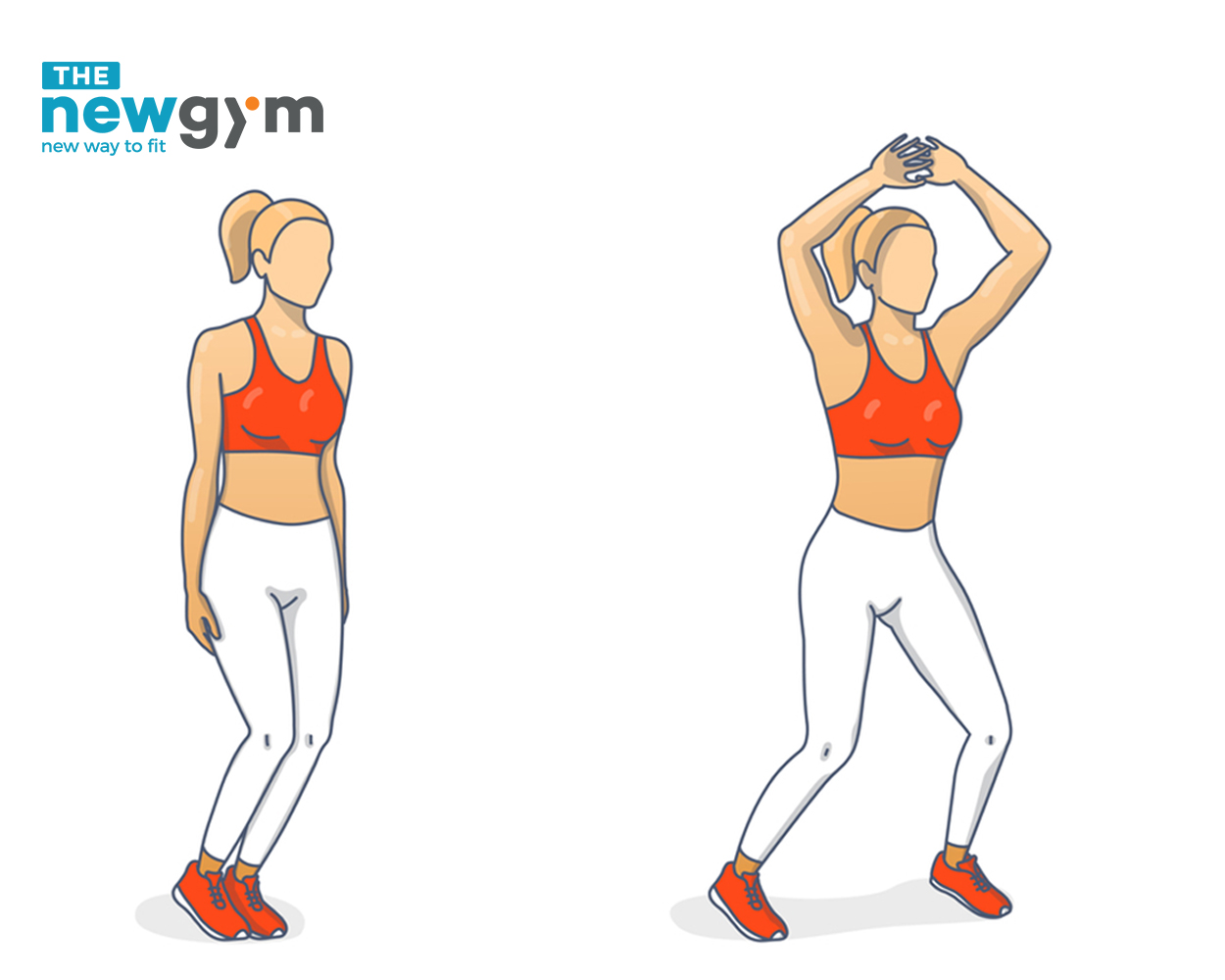
Jumping Jacks
Tabata isn’t just a trend but a training method built on solid science that maximises your body’s strength and endurance. In just 4 minutes, you can gain cardiovascular and metabolic benefits that take hours with traditional methods.
Who Should Be Careful with Tabata
The New Gym advises some groups to consult a specialist doctor before doing Tabata because of its very high intensity.
- People with a history of heart disease: High blood pressure, heart attack, heart failure, valve narrowing; get a heart check-up and ECG first. Tabata pushes your heart rate to 90-100% of HR max, which can be dangerous for people with weak hearts
- People under 18: The cardiovascular system and bones and joints are still developing, so very high intensity isn’t suitable. Favour moderate cardio and bodyweight exercises
- People over 60: Need an overall fitness assessment first. Start with a gentler version (15 seconds work – 15 seconds rest) instead of standard Tabata
- Pregnant women: ABSOLUTELY no Tabata. A sharply raised heart rate may affect the baby. See a pregnancy exercise guide for a suitable alternative plan
- People with knee, ankle or lower back injuries: Tabata often includes many Plyometric exercises (Burpees, Jump Squats) with high impact on the joints. Recover fully before starting
- People with severe asthma or chronic lung disease: Tabata causes a sudden spike in breathing rate that may trigger an asthma attack. Consult a respiratory doctor
Stop training immediately if you experience chest pain, unusual shortness of breath, dizziness or faintness. Sit or lie down somewhere airy, and call emergency services on 115 if the symptoms don’t ease after resting. This article is for reference only and does not replace professional medical advice.
FAQ: Frequently Asked Questions About Tabata Training
1. Is 4 Minutes of Tabata Really Enough to Lose Weight?
The New Gym finds that a single 4-minute Tabata only stimulates your metabolism and isn’t enough for effective weight loss. To lose weight, do Tabata 2-3 times a week combined with 1-2 weight training sessions + a calorie deficit of 300-500 kcal/day. Tabata’s strength is saving time (4-20 minutes per session) and boosting EPOC (post-workout fat burning), but it isn’t magic; you still need nutritional discipline.
2. Can You Do Tabata at Home Without Equipment?
Absolutely. Tabata suits home training with bodyweight exercises: Burpees, Mountain Climbers, Jumping Jacks, High Knees, Squat Jumps and Push-ups. The New Gym recommends beginners start with 4 simple exercises at home 2-3 times a week for the first 4 weeks before trying more complex ones. You need at least 2m² of space + a timer.
3. How Long Until You See Results from Tabata?
According to scientific research, you’ll see:
- Weeks 1-2: Improved cardiovascular endurance; you won’t get out of breath as quickly
- Weeks 3-4: Changes in your physique start to show if combined with a calorie deficit · better endurance
- Weeks 5-6: 14% increase in VO2 Max + 28% in anaerobic capacity (per the 1996 Tabata study)
- Weeks 8-12: A clearly firmer physique + much better endurance
The ideal frequency is 2-3 sessions a week combined with weight training + a well-planned diet.
4. Is Tabata Safe for Women?
Yes, with some adjustments. Women can do Tabata with 2 things in mind: (1) In the days before and during your period, you can reduce the intensity if you feel tired, (2) Women in perimenopause (40+) should start with Low-Impact Tabata (no jumping) such as Bodyweight Squat – Push-up – Plank instead of Plyometric exercises. Avoid it completely during pregnancy and the first 3 months after giving birth.
5. Is Tabata Cardio or Resistance Training?
It depends on the exercises you choose. Tabata with running, cycling or High Knees is cardio, while Tabata with Squat Jumps, Push-ups or Lunges is bodyweight resistance training. Whichever you choose, the structure of 20 seconds of effort and 10 seconds of rest pushes your heart rate up, so every Tabata session works your cardiovascular system.
6. How Is Tabata Different from Cardio?
They differ in intensity and duration. Tabata works near maximum for 20 seconds with 10 seconds of rest, each round just 4 minutes, while regular cardio keeps a moderate intensity continuously for 30–60 minutes. So Tabata saves time but is more tiring and needs more recovery between sessions.
7. Is Tabata a Type of HIIT?
Yes. Tabata is a form of HIIT with a fixed formula: 20 seconds of near-maximum effort, 10 seconds of rest, repeated 8 times over 4 minutes. HIIT is the umbrella term, allowing more flexible work and rest times, for example 30 seconds work, 30 seconds rest.
Tabata suits you when you’re short on time but already have a fitness base, and should be done 2–3 times a week alternating with weight training. At The New Gym, you can do Tabata in the Functional Training zone, which has space for jumping exercises. Most locations are open 24/7, and first-time visitors get 7 days of free training to try before signing up.

About The New Gym
The New Gym is a gym chain with 15 clubs in Ho Chi Minh City, Can Tho, Da Nang and Dong Nai. Most clubs are open 24/7, while Can Tho and Bien Hoa are open from 5am to midnight (see opening hours for each club). Memberships start from 299,000 VND/month on the 6-month plan, including 11+ free group classes. Guided by our “Gym for everyone” philosophy, first-time visitors get a 7-day free trial.
📞 Hotline: 1900 63 69 20
📌 Facebook: facebook.com/thenewgymvietnam
💬 Zalo: zalo.me/4267108480570109866


