
Last updated: 01/07/2026
HIIT (high-intensity interval training) is a short but high-intensity training method that many busy people choose because the sessions are short. The New Gym explains what HIIT is, how it works, its real benefits and what you need to know before you start.
What Is HIIT? Definition and How It Burns Fat
HIIT (short for High-Intensity Interval Training) is a cardio training method that alternates periods of maximum-intensity effort (around 80-95% of your maximum heart rate) with periods of rest or low-intensity exercise.
Done at the right intensity, HIIT pushes your body to work near its maximum in each burst, creating a more noticeable post-workout calorie burn than light cardio. People who don’t reach enough intensity during the work periods are really doing regular cardio, not HIIT.
| Factor | HIIT characteristics |
| Intensity | Very high (near maximum) |
| Session length | Short, usually 20 – 30 minutes per session |
| Structure | Maximum effort -> Rest/Recovery -> Repeat |

How HIIT Burns Fat: The EPOC Effect
The biggest difference between HIIT and regular cardio isn’t the calories burned during the workout but the calories burned after you finish.
When you push your body to work at very high intensity, it runs a temporary oxygen deficit. After the session ends, your body has to consume more oxygen than usual to return to balance, and this process is called EPOC (excess post-exercise oxygen consumption), also known as the EPOC effect (afterburn effect). This “oxygen debt repayment” helps your body burn some extra calories after training, though the amount is usually not large.
A systematic review by Jagsz and Sikora (2025) in the Journal of Clinical Medicine found that both HIIT and moderate-intensity cardio help people with obesity lose fat, and most studies found no meaningful difference between the two. HIIT worked best in people aged 18–30, while people aged 41–60 found it easier to stick with moderate cardio. So choose HIIT because it saves time, not because it definitely burns more fat than regular cardio. To compare other interval training styles, see our articles on Tabata and HIIT vs SIT.
What Are the Health Benefits of HIIT?
HIIT isn’t just a fat-burning method but an all-round tool for improving your fitness, physiology and quality of life, especially when life is busy:
Burns more calories in less time
A HIIT session lasts just 15–30 minutes but still burns a significant number of calories thanks to the high intensity and the post-workout EPOC effect. That’s why HIIT suits people with little time who still want effective fat burning.
Improves insulin sensitivity
HIIT helps your body respond better to insulin, making it more efficient at using carbohydrates for energy instead of storing them as fat. This is important for keeping blood sugar stable.
Temporarily boosts growth hormone (GH)
The high intensity of High Intensity Interval Training (HIIT) can temporarily increase Growth Hormone (GH). However, this short-term rise isn’t what decides fat burning or muscle gain.
Relieves stress effectively
High-intensity exercise releases a strong rush of endorphins, effectively easing stress and sharpening your focus after the workout.

Helps keep muscle while losing fat
HIIT helps burn fat while preserving lean muscle mass, especially when combined with weight training and enough protein.
Improves explosive endurance
Regular HIIT increases cardiovascular endurance and explosive power, which benefits sports that need speed like football, badminton and martial arts.
HIIT vs Traditional Cardio Comparison Table
Understanding the differences helps you choose the right method for your goals and the time you have.
| Criteria | HIIT | Moderate-intensity cardio (LISS) |
|---|---|---|
| Session length | 15-30 minutes | 45-90 minutes |
| Intensity | Very high (80-95% of heart rate) | Moderate (50-70% of heart rate) |
| Calories burned after training | A little extra (EPOC effect) | Less |
| Muscle retention | Similar if you eat enough protein and lift weights | Similar if you eat enough protein and lift weights |
| Best for | Busy people with a fitness base | Beginners, injury recovery |
| Maximum frequency | 3-4 sessions a week | Can be daily |
Who Is HIIT Right For?
HIIT isn’t right for everyone. Below are the groups who benefit most and the groups who need to be careful.
Good fit:
- Busy people: Just 20-30 minutes to effectively meet your activity goals
- People hitting a weight-loss plateau: When your body is used to light cardio, changing your training style can help you break through, along with reviewing your diet
- People wanting to keep muscle while losing fat: short HIIT sessions leave you energy for weight training, helping preserve muscle
- Athletes needing explosive endurance: Football, badminton and martial arts all benefit from improved cardiovascular fitness
Be careful or avoid:
- People with heart disease, high blood pressure or asthma should consult a doctor first
- Complete beginners with no fitness base should do light cardio for 4-6 weeks first
- People recovering from an injury
Popular Equipment-Free HIIT Exercises
7 equipment-free HIIT exercises you can do right away on the gym floor or at home: High Knees, Mountain Climbers, Butt Kicks, Jumping Jacks, Lunge Jumps, Lunges and Push-ups.
1. High Knees
High Knees means running on the spot, driving your knees up to hip height to raise your heart rate quickly. (Suitable for beginners when done slowly.)
- Stand tall, feet hip-width apart, elbows bent and hands in front of your belly.
- Drive your right knee up to hip height while swinging your left arm up as if running.
- Land your right foot on the ball of the foot and immediately switch to your left knee.
- Alternate continuously, keeping your back straight and abs tight.
Beginners can march with high knees instead of jumping to reduce stress on the knees.
2. Mountain Climber
The Mountain Climber combines holding a plank with fast knee drives, working your abs and raising your heart rate.
- Get into a high plank, hands directly under your shoulders, body straight from head to heels.
- Drive your right knee toward your chest, keeping your left leg straight.
- Bring your right foot back while driving your left knee up.
- Switch legs continuously, keeping your hips low and level with your shoulders without piking your glutes up.
Common mistakes and fixes are in our Mountain Climber guide.

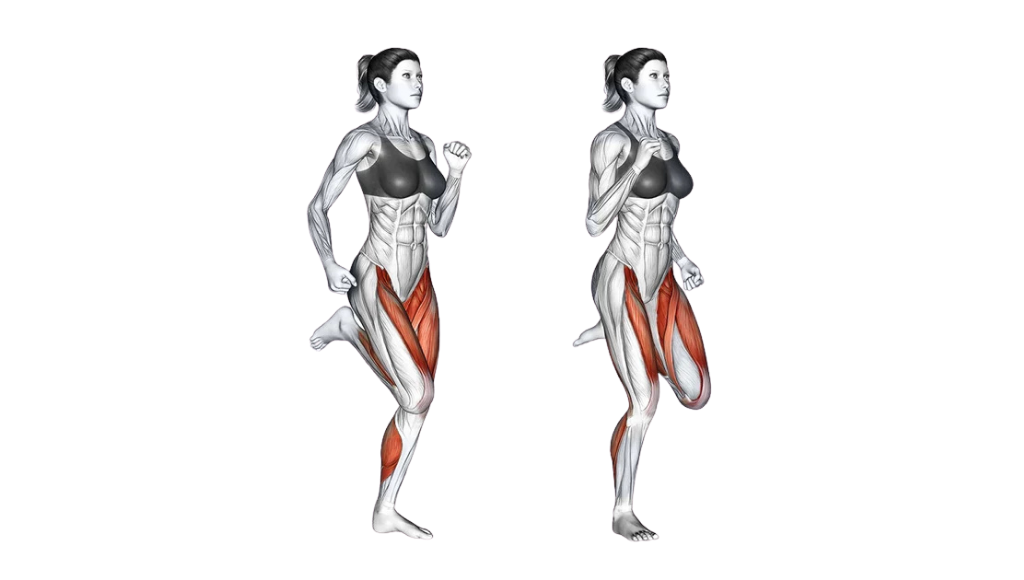
3. Butt Kicks
Butt Kicks means running on the spot, bringing your heels toward your glutes to warm up your hamstrings.
- Stand tall, feet hip-width apart.
- Run on the spot, kicking your heels back toward your glutes with each step.
- Swing your arms as if running, keeping your thighs almost vertical.
- Land lightly on the balls of your feet and keep a steady rhythm.
4. Jumping Jacks
Jumping Jacks are a jumping exercise where you spread your legs and raise your arms overhead, used to raise your whole-body heart rate.
- Stand tall, feet together, arms by your sides.
- Jump your feet out wider than your shoulders while raising your arms overhead.
- Jump your feet back together, bringing your arms back to your sides.
- Repeat continuously, landing lightly on the balls of your feet with a slight bend in your knees.
Beginners can step out to the side one leg at a time instead of jumping.
5. Lunge Jumps
Lunge Jumps are the highest-impact exercise on the list, so only do them once you’ve mastered regular Lunges.
- Start in a lunge, right foot forward, both knees bent about 90 degrees.
- Jump up explosively and switch your legs in mid-air.
- Land softly in a lunge with your left foot forward.
- Repeat continuously, keeping your upper body upright and your front knee from caving in.
6. Lunges
Lunges are a non-jumping exercise that works your thighs and glutes with low impact. (Suitable for beginners.)
- Stand tall, feet hip-width apart, hands on your hips.
- Take a long step forward with your right foot.
- Lower yourself until both knees are bent about 90 degrees, your back knee almost touching the floor.
- Push through your front heel to return to standing, then switch legs.
The step-back variation (Reverse Lunges) puts less stress on the knees and is covered in our Lunges guide.
7. Push-up
The Push-up is a bodyweight pressing exercise for the chest, shoulders and triceps. (Suitable for beginners.)
- Get into a high plank with your hands slightly wider than your shoulders.
- Squeeze your abs and glutes so your body is straight from head to heels.
- Lower your chest until it almost touches the floor, elbows angled about 45 degrees from your body.
- Push yourself up, working continuously for the set time instead of counting reps.
Beginners can go on their knees or put their hands on a bench to reduce the load. Detailed technique is in our push-up guide.
Once you’re comfortable with the 7 exercises above, you can make it harder by swapping Lunges for Lunge Jumps, or adding Burpees and Jump Squats to your session.
Key Numbers for Getting the Most Out of HIIT
HIIT is only truly effective when you control the following parameters:
| Parameter | Target (for Men & Women) | Important Notes |
| Target Heart Rate | 80% – 95% of maximum heart rate (MHR). | Use the formula: 220 – Age |
| Recovery Nutrition | Have fast-acting protein + carbs within 30 minutes. | See post-workout recovery nutrition. |
| Rest Time | A 1:1 or 1:2 ratio (30s work – 30/60s rest). | Resting too long reduces the fat-burning effect. |
| Equipment | Favour Free Weights or the treadmill. | Make sure your technique is right to avoid injury. |
Common Mistakes & Tips to Maximise Fat Burning with HIIT
- Training too long: Your body can’t sustain near-maximum intensity for more than 20–30 minutes, so longer HIIT sessions usually turn into moderate cardio, with a higher risk of fatigue and injury
- Ignoring nutrition: HIIT burns a lot of calories, and not eating enough protein afterwards leads to muscle loss instead of fat loss
- Too many sessions a week: More than 4 HIIT sessions a week overloads the central nervous system, disrupts sleep and lowers training performance
- Skipping the warm-up: High-intensity training before your muscles are warm significantly increases the risk of ankle and knee injuries
Some Limitations of HIIT
Even though it saves time, HIIT isn’t right for everyone at all times. Some limitations include:
Easy to overtrain: If you do HIIT more than 4 times a week, your body can become exhausted, with poor sleep and lower training performance.
Stress on the central nervous system: Very high intensity easily fatigues your nervous system without a sensible rest schedule.
Higher injury risk: Exercises like Jump Squats and Burpees need good technique. If your form breaks down when you’re tired, you can easily injure your ankles or knees.
Not for people with underlying conditions: People with heart, blood pressure or asthma problems need to be very careful with HIIT.

Frequently Asked Questions
Q1: I’ve been doing HIIT but my weight isn’t going down? Answer: You may be eating too much to make up for the exercise. HIIT burns calories, but if you reward yourself with a milk tea afterwards, you’ll take in more calories than you burned. Control your diet to see results.
Q2: Will HIIT make women’s calves bulky? Answer: No. HIIT focuses on burning calories across your whole body. Moves like Squats and Lunges make your glutes and thighs firmer, and won’t make your legs bulky when done at a moderate level.
Q3: I’m so busy I don’t even have 20 minutes. What can I do? Answer: Plenty! 10 minutes of truly explosive effort is still better than nothing. The key to HIIT is maximum effort in the shortest time you have.
Q4: Should I do HIIT before or after weight training? Answer: It’s best after your weight session or on a separate day.
Q5: Should I shower right after HIIT? Answer: No. Your body needs at least 20-30 minutes to cool down and settle your heart rate. Wipe off the sweat and do some gentle stretching in The New Gym’s rest area before showering.
Q6: How is HIIT different from regular cardio? Answer: HIIT alternates near-maximum bursts (about 80–95% of maximum heart rate) with rest periods, while regular cardio stays at a moderate intensity (about 50–70%) continuously. So a HIIT session is shorter, usually 15–30 minutes, but more tiring and needs more recovery time between sessions.
Q7: How many times a week should beginners do HIIT? Answer: 1–2 sessions a week, at least 1 day apart, then build up as your body adapts to the intensity. Even once you’re experienced, don’t go over 3–4 HIIT sessions a week so your body can recover.
Understanding what HIIT is and applying the right formula helps you save time while still reaching your fat loss goals. Most important is hitting the right intensity during the work periods, keeping it to no more than 4 sessions a week and getting good recovery nutrition after training.
To do high-intensity group classes like Bootcamp or Cardio & Core, The New Gym invites you to try 7 days of free training at any of our 15 locations nationwide.
⚡Articles on HIIT
A collection of 37 articles about HIIT, ordered by how often they are read.
- The secret to staying in shape with just 10 minutes of HIIT a day
- What Is HIIT Pilates? 6 Combined Exercises to ‘Burn Fat and Build Endurance’
- Lower Body HIIT: Seriously ‘Fiery’ Legs & Glutes
- HIIT for Weight Loss with 6 Effective Fat-Burning Exercises
- Rowing HIIT: A Fat-Burning ‘Weapon’ for Full-Body Endurance
- Master the Exercise Bike with an Advanced HIIT Plan
- HIIT with Weights: An Effective, Sustainable Weight Loss Plan
- 3 jump rope HIIT cardio plans at the gym for every level
- HIIT Cardio for Men: Burn Off Excess Fat, Unleash Your Strength
- HIIT vs Running: Which Gets You Lean Faster?
See 25 more articles ▾
- HIIT Workouts for Women: 3 Effective Fat-Burning Plans by Goal
- Burn Your Upper Body with a Complete HIIT Plan for Arms, Shoulders and Back
- Low-Impact HIIT: A Lifesaver for Your Knees and Back
- HIIT vs SIT: Which Will Help You Break Your Limits?
- Top 5 most effective belly fat exercises for men
- Metabolic Workout: Rapid Fat Burning & a More Youthful Physique for Women
- Top 2 most effective HIIT workouts for beginners
- Burn 500 calories with a 25-minute HIIT workout
- Just 10 Minutes a Day with 7 ‘Express’ HIIT Plans
- HIIT at Home with 5 ‘Rapid Fat-Burning’ Plans for Busy People
- A Treadmill HIIT Guide: The Secret to Effective Weight Loss
- Burn Fat and Build Full-Body Endurance with Kettlebell HIIT
- HIIT for Older Adults: Everything About Plans and Benefits
- A Guide to Burning Fat and Building Heart Health with Elliptical HIIT
- HIIT vs LISS: Which Cardio Style Burns Fat Better?
- 3 HIIT Plans by Level and a Detailed 4-Week Schedule
- What Is AMRAP? How to Train Effectively and Key Tips
- What Is EMOM? How to Do It and the Benefits for Beginners
- What Is the Afterburn Effect? EPOC, What Affects It and How to Maximise It
- What Is RFT (Rounds For Time)? How to Train and Key Tips
- Go All Out in 20 Minutes: The Complete Guide to HIIT and a Sample Plan
- A HIIT Training Guide for Every Type of Person

About The New Gym
The New Gym is a gym chain with 15 clubs in Ho Chi Minh City, Can Tho, Da Nang and Dong Nai. Most clubs are open 24/7, while Can Tho and Bien Hoa are open from 5am to midnight (see opening hours for each club). Memberships start from 299,000 VND/month on the 6-month plan, including 11+ free group classes. Guided by our “Gym for everyone” philosophy, first-time visitors get a 7-day free trial.
📞 Hotline: 1900 63 69 20
📌 Facebook:facebook.com/thenewgymvietnam
💬 Zalo:zalo.me/4267108480570109866


