
Leg exercises are exercises that target the four main muscle groups of the lower body: the quads, hamstrings, glutes and calves. A complete leg workout needs at least one compound exercise for the whole lower body, one dedicated hamstring exercise and one dedicated glute exercise, because the Squat alone does not cover all four groups.
Many people skip leg day because it feels heavy and leaves them sore for a long time, but this is the largest muscle group in the body and it directly affects your posture and overall strength.
The New Gym brings you 15 leg exercises you can do at the gym and at home.

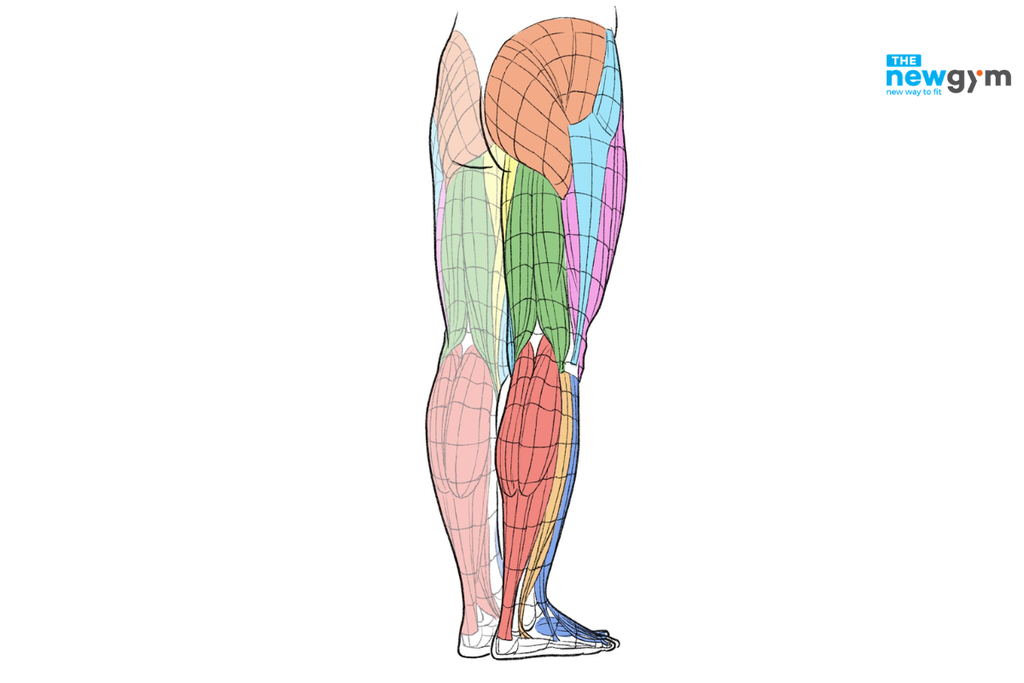
What are the leg muscle groups?
| Muscle group | Location | Main function | Signature exercises |
|---|---|---|---|
| Quadriceps | Front of the thigh | Knee extension | Squat, Leg Extension |
| Hamstrings | Back of the thigh | Knee flexion, hip extension | Romanian Deadlift, Leg Curl |
| Glutes | Buttocks | Hip extension, hip abduction | Hip Thrust, Bulgarian Split Squat |
| Calves | Back of the lower leg | Pointing the toes (plantar flexion) | Calf Raise |
| Adductors | Inner thigh | Bringing the legs inward | Sumo Squat |
Quadriceps: the muscle group on the front of the thigh, responsible for knee extension. The quads provide most of your strength when you stand up from a chair, climb stairs or rise from a squat.
Hamstrings: the muscle group on the back of the thigh, responsible for knee flexion and hip extension. The hamstrings are the most often neglected group because the Squat does not work them much, and an imbalance between the quads and hamstrings increases the risk of injury when running.
Glutes: the largest muscle group in the body, responsible for hip extension and keeping the pelvis stable. Strong glutes support the lower back, so people who sit a lot at work often notice a clear difference when they start training this group.
Calves: the muscle group on the back of the lower leg, responsible for rising onto your toes and keeping your ankles balanced. Squats work the calves very little, so they need their own exercise.
Adductors: the muscle group on the inner thigh, which keeps you stable when you stand on one leg or change direction suddenly.
No single exercise covers all four main groups deeply enough. The Squat works the quads and glutes hard but barely touches the hamstrings and calves, so a leg workout needs several exercises in different directions of movement.
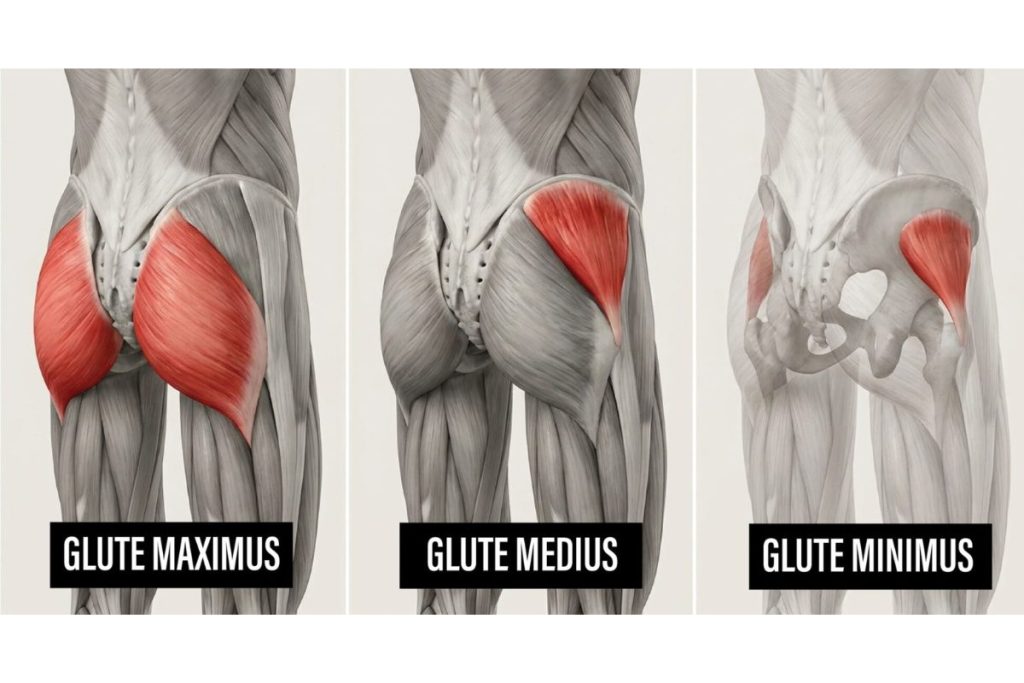
The glute muscles
The glutes are not one single muscle but three muscles layered on top of each other, each responsible for a different direction of movement. That is why a leg workout with only Squats and Hip Thrusts still misses part of this muscle group.
| Muscle | Location | Main function | Signature exercises |
|---|---|---|---|
| Gluteus maximus | The outermost layer, making up most of the buttocks | Hip extension, external rotation of the thigh | Hip Thrust, Romanian Deadlift, Bulgarian Split Squat |
| Gluteus medius | Side of the hip, under the gluteus maximus | Abducts the thigh, keeps the pelvis level when standing on one leg | Cable Hip Abduction, Banded Side Walk, Curtsy Lunge |
| Gluteus minimus | The deepest layer, under the gluteus medius | Assists hip abduction and rotation, stabilises the pelvis | Clamshell, Fire Hydrant, Single-Leg Glute Bridge |
The gluteus maximus is the largest muscle in the body. It works hardest in movements that drive the hips forward: standing up from a chair, climbing stairs, sprinting. It is also the muscle that most popular leg exercises work.
The gluteus medius works in a completely different direction. Every time you take a step, the gluteus medius on your standing leg contracts to stop your pelvis dropping towards the lifted leg. When this muscle is weak, your knees tend to cave inward when squatting and walking downstairs, and your hips lack stability when running.
The gluteus minimus works together with the gluteus medius and is almost impossible to isolate with a specific exercise. Exercises that target the gluteus medius also recruit the gluteus minimus.
Leg and glute exercises to tone the legs for men and women
The list below is a library to choose from based on the equipment you have, not a plan for a single session. Each leg session only needs 4 to 6 exercises.
Compound leg exercises at the gym
1. Barbell Squat
The Barbell Squat works the quads and glutes hardest, while also recruiting the core and lower back to hold your torso steady. It is the leg exercise that lets you lift the heaviest weight.
- Rest the bar on your upper back, feet shoulder-width apart, toes turned slightly out.
- Take a deep breath, brace your core, push your hips back and lower your body.
- Lower until your thighs are parallel to the floor or below, keeping your knees in line with your toes.
- Drive through your heels to stand up, squeezing your glutes at the top.
Mistake to avoid: letting your knees cave in as you stand up. See the technique details in The New Gym’s article on how to squat correctly.
2. Goblet Squat
The Goblet Squat is a variation where you hold the weight against your chest, which keeps your torso more upright and reduces the load on your lower back. It is the best exercise for beginners learning the squat.
- Hold a dumbbell or kettlebell close to your chest, elbows pointing down.
- Lower your hips between your heels, keeping your chest open and back straight.
- Lower until your elbows touch or nearly touch the inside of your thighs.
- Drive through your heels to stand up.
See the full guide in our article on the Goblet Squat.
3. Leg Press
The Leg Press lets you train your quads and glutes with heavy weights without loading your spine, so it suits people with lower back pain or those not yet used to holding their torso under a barbell.
- Sit in the machine with your back against the pad and place your feet shoulder-width apart on the platform.
- Push the platform away with your whole foot until your legs are almost straight, without locking your knees.
- Bend your knees to lower the platform with control, stopping when your thighs are close to your chest.
- Push again without letting your lower back lift off the pad.
Placing your feet high on the platform works your glutes and hamstrings more, while placing them low works your quads more. See the details in our article on the Leg Press machine.
4. Romanian Deadlift
The Romanian Deadlift is the main exercise for the hamstrings and the posterior chain, the area the Squat does not cover.
- Stand tall holding a barbell or two dumbbells in front of your thighs, knees slightly bent.
- Push your hips back and lower the weight along the front of your legs, keeping your back straight throughout.
- Lower until you feel a clear stretch in the back of your thighs, usually once the weight passes your knees.
- Squeeze your glutes and drive your hips forward to stand up.
Mistake to avoid: bending your knees too much turns it into a conventional Deadlift. Keep the same slight knee bend from start to finish.
5. Bulgarian Split Squat
The Bulgarian Split Squat trains one leg at a time, so it fixes imbalances between the two sides while working the glutes and quads hard.
- Rest the top of your back foot on a bench and step your front foot far enough forward that your knee does not travel too far.
- Lower your body straight down until your front thigh is parallel to the floor.
- Drive through your front foot to stand up, keeping your torso stable.
- Finish all reps on one side, then switch legs.
A longer stride works your glutes more, while a shorter stride works your quads more. See the details in our article on the Bulgarian Split Squat.
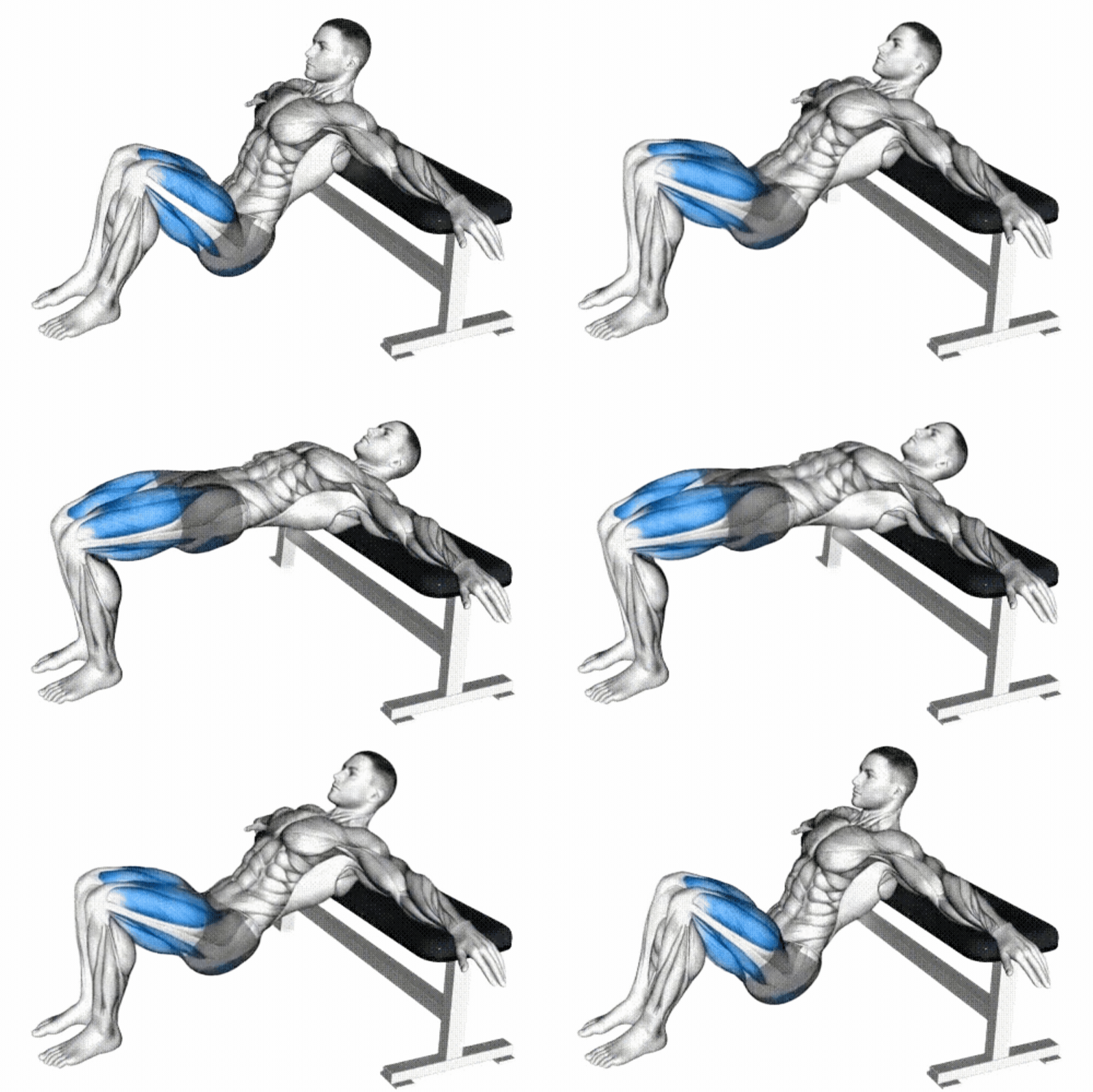
6. Hip Thrust
The Hip Thrust works the glutes harder than any other lower-body exercise, because its direction of movement matches the glutes’ job of extending the hips.
- Sit on the floor with your back against the edge of a flat bench, just below your shoulder blades.
- Place a padded barbell across your hips, bend your knees and keep both feet flat on the floor.
- Squeeze your glutes and core and drive your hips up until your body forms a straight line from shoulders to knees.
- Hold for a moment, then lower your hips with control.
Mistake to avoid: arching your lower back instead of extending your hips. Keep your chin slightly tucked to control your position.
7. Dumbbell Lunge
The Dumbbell Lunge works the glutes, quads and hamstrings while training your balance.
- Stand tall with a dumbbell in each hand by your sides.
- Step one foot forward and lower your body until your back knee nearly touches the floor.
- Keep your torso upright and your front knee in line with your toes.
- Drive through your front heel to return to the start, then switch legs.
Mistake to avoid: leaning forward as you lower, which takes work away from the glutes.
8. Box Step-up
The Box Step-up is a simple yet effective exercise for the glutes and quads, and it closely mirrors climbing stairs in daily life.
- Stand in front of a sturdy box; you can hold dumbbells to make it harder.
- Place your whole foot on the box and push through that leg to lift yourself up.
- Stand tall on the box, avoiding pushing off with your lower leg for momentum.
- Lower your leg slowly and with control, then switch sides.
Isolation leg exercises at the gym
9. Leg Extension
The Leg Extension isolates the quads, making it a good way to add volume for this group after compound exercises.
- Sit in the machine and adjust the seat so your knees line up with the machine’s pivot point.
- Hook your ankles under the pad and hold the handles on both sides.
- Straighten your legs, hold for one second and squeeze your quads.
- Lower slowly without letting the weight drop.

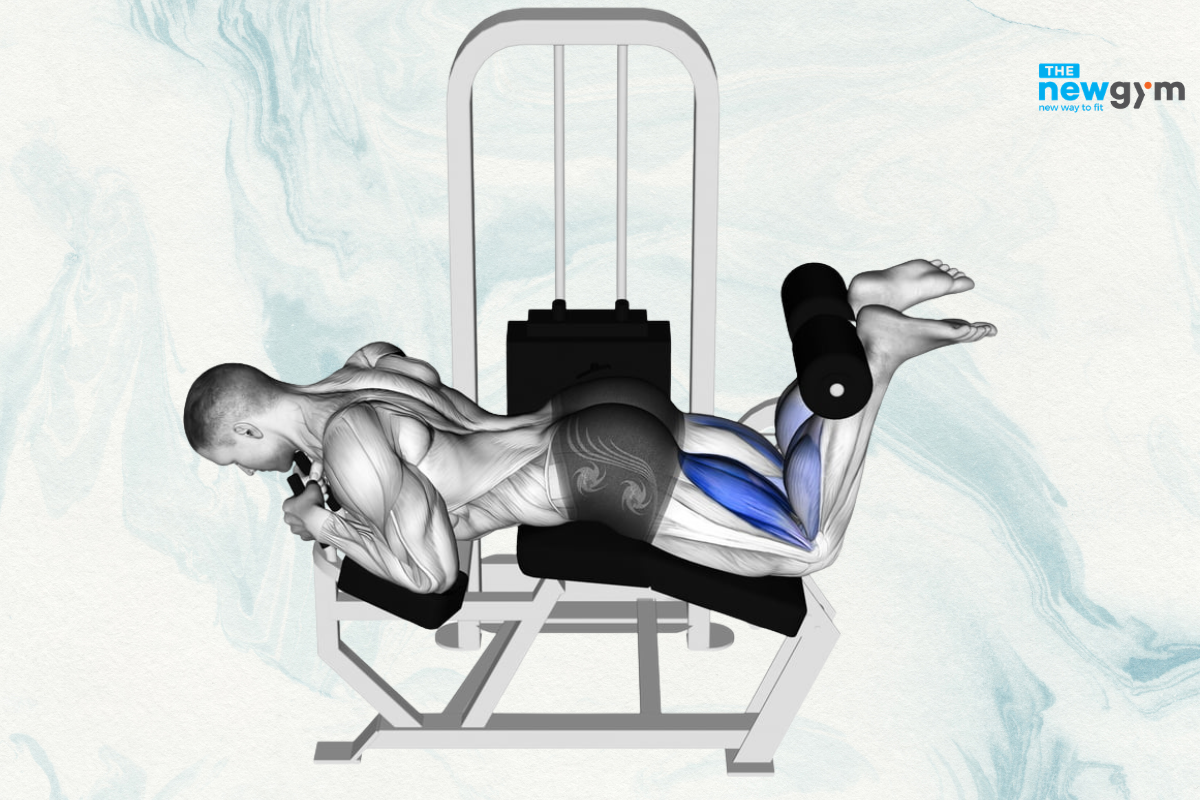
10. Leg Curl
The Leg Curl isolates the hamstrings through knee flexion, complementing the Romanian Deadlift, which focuses on hip extension.
- Lie face down or sit in the machine depending on the type, with your heels under or on top of the pad.
- Adjust the machine so your knees line up with the pivot point.
- Bend your knees to pull the pad through the full range of motion and hold for a moment.
- Straighten your legs slowly, keeping tension on the muscle.
11. Cable Kickback
The Cable Kickback isolates the glutes with constant tension throughout the movement, making it a good finisher at the end of a session.
- Attach an ankle strap and hook it to the pulley at its lowest setting.
- Lean slightly forward and hold the machine frame for balance.
- Kick your leg back using your glutes, keeping your back from arching.
- Squeeze your glutes at the top and lower your leg slowly.
12. Calf Raise
The Calf Raise is the main exercise for the calves, a muscle group squats barely work.
- Stand tall with the balls of your feet on a step or the edge of a platform.
- Rise onto your toes as high as you can and hold for one second.
- Lower your heels below the platform to stretch your calves.
- Repeat at a slow tempo without bouncing.
Leg exercises at home, no equipment needed
13. Bodyweight Squat
The Bodyweight Squat is the foundation of the home routine, using only your body weight.
- Stand with your feet shoulder-width apart, toes turned slightly out.
- Push your hips back and lower your body, reaching your arms forward for balance.
- Lower until your thighs are parallel to the floor, or lower if your ankles are mobile enough.
- Drive through your heels to stand up, squeezing your glutes at the top.
14. Reverse Lunge
The Reverse Lunge steps backwards, so it is easier on the knees than a forward lunge and suits beginners or people who have had knee pain.
- Stand tall with your hands on your hips.
- Step one foot back and lower your body until both knees are at about 90 degrees.
- Keep your torso upright with your weight on your front leg.
- Drive through your front heel to stand up, then switch sides.
15. Glute Bridge
The Glute Bridge activates the glutes while lying down, making it a good warm-up or a main exercise when training at home.
- Lie on your back with your knees bent and feet flat on the floor, hip-width apart.
- Squeeze your glutes and abs and press your heels into the floor to lift your hips.
- Hold for 1 to 2 seconds at the top, forming a straight line from shoulders to knees.
- Lower your hips slowly without fully touching the floor between reps.
3 extra variations if you want a longer home workout: the Wall Sit, holding a seated position against a wall with your thighs parallel to the floor to build quad endurance; the Single-Leg Calf Raise, rising onto the toes of one foot to load the calves more; and the Side Leg Raise, lying on your side and lifting your top leg to work the hip abductors.
Leg exercises for men
Men train legs with the same exercises; the difference lies in prioritising heavier loads and compound lifts. Their plans usually revolve around the Barbell Squat or Leg Press at heavy weights, combined with the Romanian Deadlift for the hamstrings.
The calves are the group men most often neglect when training at home. Adding Single-Leg Calf Raises or Calf Raises at the end of each session is the cheapest way to balance out the lower legs.
Thigh size depends on both your bone structure and the length of your muscle bellies, two factors determined by genetics. Training volume and gradually increasing the weight over time are the parts you can influence.
Leg and glute exercises for women
Women train legs with the same exercises as men; the difference lies in the weights and the balance between exercises. The Hip Thrust, Bulgarian Split Squat and Cable Kickback are usually prioritised because they target the glutes directly.
Lifting weights does not make women’s legs grow quickly. Women have much lower testosterone levels than men, so muscle gain is significantly slower, and moderate weights at 10 to 15 reps mainly create definition.
If you are new and still unsure, The New Gym offers a 7-day free trial. Explore our spacious training floor and international-standard machines, join free group classes and use every facility across The New Gym’s 24/7 clubs.

Sample leg workout
| Order | Exercise | Sets × reps |
|---|---|---|
| 1 | Goblet Squat or Barbell Squat | 4 × 8 – 12 |
| 2 | Romanian Deadlift | 3 × 10 – 12 |
| 3 | Bulgarian Split Squat | 3 × 10 per leg |
| 4 | Hip Thrust | 3 × 12 – 15 |
| 5 | Leg Curl | 3 × 12 – 15 |
| 6 | Calf Raise | 3 × 15 – 20 |
The order goes from the heaviest compound exercise to isolation exercises. The exercise that demands the most technique and strength should come first in the session, while you are still fresh.
Warm up for 5 to 10 minutes with light cardio and hip, knee and ankle rotations, then do 1 to 2 sets of bodyweight squats before the main exercises.
For a home session, switch to: Bodyweight Squat, Reverse Lunge, Glute Bridge, Wall Sit and Single-Leg Calf Raise, 3 sets each.
5 common mistakes when training legs
Letting your knees cave in: when squatting or lunging, knees caving inward increases stress on the inner ligaments. What matters is that your knees track in line with your toes, not whether they pass beyond your toes.
Lifting your heels off the floor: usually caused by limited ankle mobility. Keep your whole foot flat and drive through your heels, or put a thin plate under your heels if your ankles are still stiff.
Rounding your lower back when lowering the weight: especially in the Romanian Deadlift. Keep a neutral spine and shorten the range of motion if you cannot keep your back straight at depth.
Only training the quads: a session with only Squats, Leg Press and Leg Extensions misses the hamstrings and calves. Every session needs at least one exercise for the posterior chain.
Using momentum instead of control: dropping the weight on the way down loses most of the muscle’s work. Lower over 2 to 3 seconds in every exercise.
FAQ about leg exercises
How many exercises should a leg workout have?
A leg workout should have 4 to 6 exercises, including 1 to 2 compound exercises, one for the hamstrings, one for the glutes and one for the calves. The 15 exercises in this article are a library to choose from, not a plan for a single session.
How many times a week should I train legs?
Training legs twice a week is enough for most people, at least 48 hours apart. The lower body is the largest muscle group, so it needs more recovery time than other groups. People with more than 6 months of training can keep 2 sessions but split them into two types: one focused on pushing movements such as the Squat and Leg Press, and one focused on the posterior chain such as the Romanian Deadlift and Hip Thrust.
What is the best leg exercise for beginners?
The Goblet Squat is the best exercise for beginners because holding the weight against your chest keeps your torso upright and makes the movement easy to learn. Adding Glute Bridges for the glutes and the Leg Press for volume is enough for the first 4 to 6 weeks.
Which exercise works the glutes the most?
The Hip Thrust works the glutes the most because its direction of movement matches this muscle group’s job of extending the hips. The Bulgarian Split Squat and Cable Kickback are two additional exercises that work them from different angles.
Will training legs make women’s legs bigger?
Training legs with moderate weights does not make women’s legs grow quickly. Women have much lower testosterone levels than men, so muscle gain is significantly slower. Skipping leg training for fear of bulky legs actually makes your muscle mass shrink over time, and your lower body looks less toned rather than slimmer.
Does training legs reduce fat on the thighs and calves?
Training legs does not reduce fat specifically on the thighs or calves. The body does not lose fat from chosen areas; fat decreases across the whole body when total energy burned exceeds energy taken in. Calf shape also depends on the length of the muscle belly and bone structure, two factors determined by genetics.
Does training legs before bed make them slimmer?
Training legs before bed has no slimming effect different from training in the morning. The time you train does not decide which fat stores are used, so choose a time you can stick to consistently. The same goes for massage or foam rolling: they reduce the feeling of tightness but do not burn fat.
Is training legs at home without weights effective?
Training legs at home without weights is effective at the beginning, when your body weight is still enough load for your muscles to adapt. Once you can easily do more than 25 squats, switch to single-leg variations such as the Reverse Lunge and Bulgarian Split Squat, or add load with a backpack.
Why are my legs sore for days after training?
Leg soreness lasting 2 to 3 days after a workout is a normal reaction when muscles are not yet used to the load, commonly called DOMS. The soreness decreases over the following sessions. If the pain is in your joints rather than the muscle bellies, it is a sign you need to review your technique.
Who should be careful when training legs?
People with a history of knee ligament injuries should get advice from a doctor or physiotherapist before lifting heavy. People with pain at the front of the knee when squatting deep should reduce the range of motion and prioritise the Leg Press over deep Squats. People with lower back pain should switch to the Leg Press, Hip Thrust and Goblet Squat, which put little load on the spine. People with high blood pressure should avoid holding their breath when pushing heavy weights. Pregnant women need advice from their obstetrician and should avoid lying on their back for long periods from the second trimester.
When should you see a doctor?
See a doctor if you have a sharp pain in your knee that recurs at the same point in the range of motion and lasts more than 1 to 2 weeks, if your knee is swollen and warm or clicks with pain, or if pain spreads down the back of your leg with numbness. If you feel sudden pain with a popping sound at the back of your thigh or calf, go to a medical facility immediately and call 115 if you cannot move on your own.
In short: how do you train legs and glutes properly?
Effective leg training needs to cover all four muscle groups, not just Squats: one compound exercise, one for the hamstrings, one for the glutes and one for the calves. Train twice a week with weights you can lift with good form, and increase them gradually over time. You can start with the sample workout above, or ask The New Gym staff to show you how to adjust the machines in your first session.
References
- Contreras B. et al. (2015), Journal of Applied Biomechanics: in 13 trained women, the Hip Thrust activated the gluteus maximus significantly more than the Back Squat at the same 10RM load.
- Kubo K. et al. (2019), European Journal of Applied Physiology: after 10 weeks of Squat training, the volume of the quads, adductors and gluteus maximus increased, while the hamstrings did not change significantly.
- Ramírez-Campillo R. et al. (2013), Journal of Strength and Conditioning Research: 12 weeks of single-leg Leg Press training did not reduce fat specifically in the trained leg; fat decreased in the trunk and arms.
🦵Articles on legs
A collection of 45 articles about legs, ordered by how often they are read.
- What Is Skipping Leg Day? 4 Real Consequences and a Sample Leg Plan
- Smith squat: a guide to squatting on the Smith machine for beginners
- How to Use the Leg Press for Beginners
- Goblet Squat Guide for Beginners
- Master the Single-Leg Squat Challenge (Pistol Squat)
- What Are Frog Thighs? How to Fix Them and Slim Your Thighs 2026
- What Are Lunges? Lunge Exercises for Toned Legs
- Kettlebell Swing: proper form and effective fat burning
- Hip exercises: 3 strength exercises and 5 post-workout stretches
- What Causes Big Thighs? Causes and How to Fix Them Properly
- What is the hack squat? Muscles worked and proper technique
- Knee Pain When Squatting: 4 Dangerous Form Mistakes to Fix Now
See 35 more articles ▾
- How to do high-bar and low-bar back squats with correct technique
- What Is a Step Up? Box Step-Up Guide for Toned Glutes
- A Complete Training Approach for Strong, Healthy Calves
- A Lower-Body Training Plan for Beginners
- Top 10 Effective Thigh Exercises for Women for Slim, Toned Legs
- 5 reasons your calves won’t grow and how to fix it
- 6 Effective Quad Exercises for Strong, Toned Legs
- What is the leg curl? A guide to proper technique
- Top 7 most effective dumbbell leg exercises for women
- How to Jump Higher: A Plan + Exercises to Boost Vertical Jump for Gym-Goers
- Inner Thigh Exercises: 15 Moves for Slimmer Thighs
- A 45-Minute Leg Workout Inspired by Athlete Chris Hoy
- Exercises for Slim, Toned Thighs at Home
- Dumbbell Leg Workout: 5 Exercises for Slim Thighs and Firm Glutes
- Top 10 most effective thigh exercises for women with a sample plan
- How to squat correctly: 4 principles for beginners
- 6 safe quad exercises for people with knee pain
- What Is a Wall Sit? How to Do It with Proper Technique
- What Is a Box Jump? A Guide to Proper Technique
- Leg Machines: How to Use the 4 Most Common Types
- What is the barbell squat? How to do it and choose the right weight for beginners
- What is the Bulgarian split squat? Proper form for beginners
- What is the front squat? Proper form and how it compares with the regular squat
- What Is the Leg Extension? Benefits and Proper Technique
- Can’t Squat Deep? 5 Exercises for Hip and Ankle Mobility
- What is the sumo squat? Muscles worked and proper form for your glutes
- What Is an Air Squat? Proper Technique and Benefits
- 4 Lower-Body Hypertrophy Exercises for Effective Muscle Gain
- What are bow legs? Signs and corrective exercises
- Knee Pain at the Gym? 10 Thigh Exercises to Protect Your Knees
- The Best Free-Weight Lower-Body Plan for Your Physique
About The New Gym
The New Gym is a gym chain with 15 clubs in Ho Chi Minh City, Can Tho, Da Nang and Dong Nai. Most clubs are open 24/7, while Can Tho and Bien Hoa are open from 5am to midnight (see opening hours for each club). Memberships start from 299,000 VND/month on the 6-month plan, including 11+ free group classes. Guided by our “Gym for everyone” philosophy, first-time visitors get a 7-day free trial.
📞 Hotline: 1900 63 69 20
📌 Facebook: facebook.com/thenewgymvietnam
💬 Zalo: zalo.me/4267108480570109866


